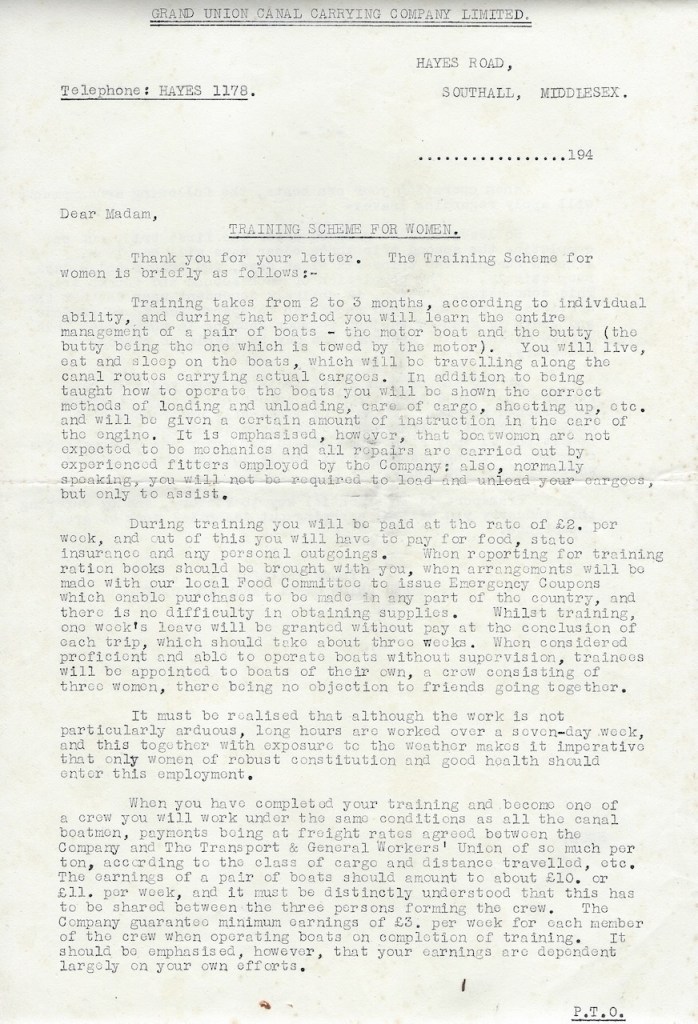
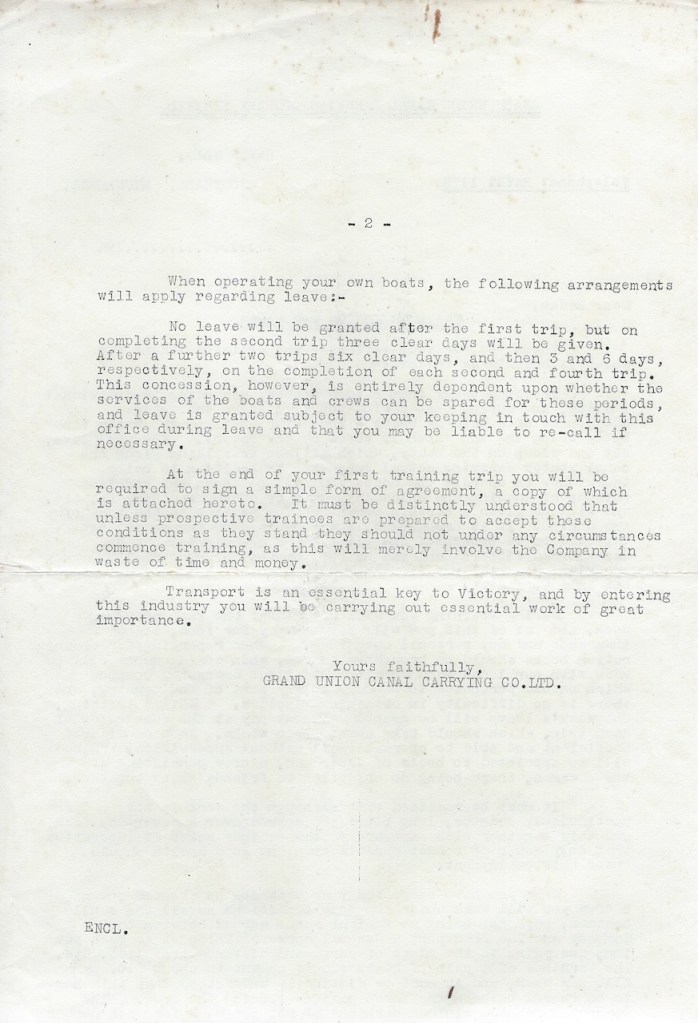
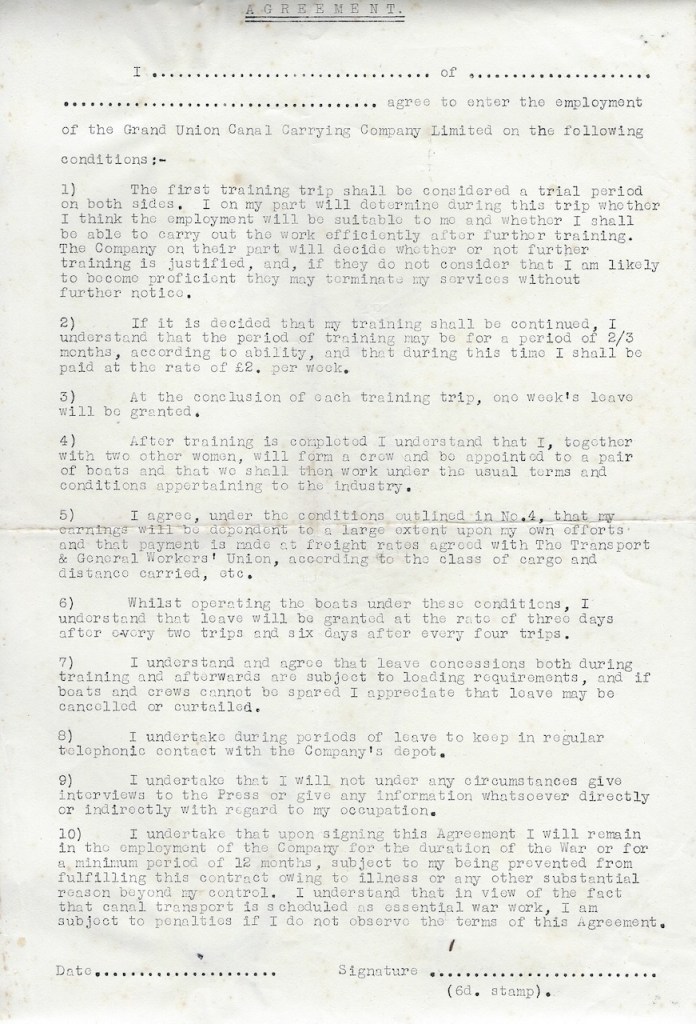
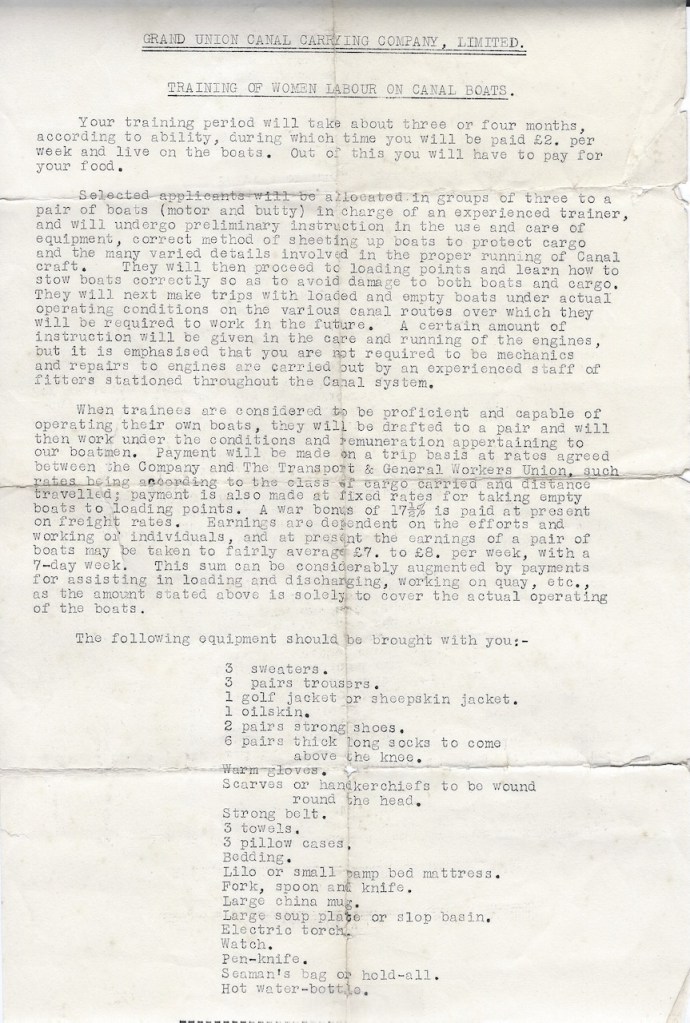
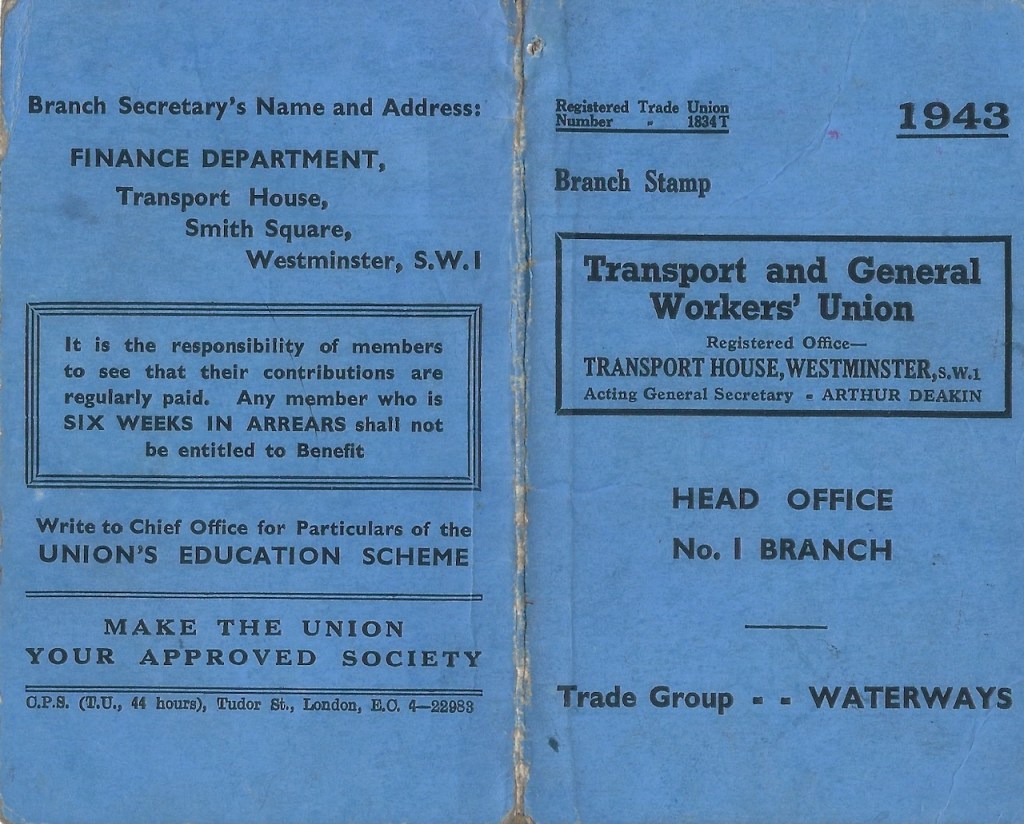
This should be read in conjunction with the Training Scheme correspondence and documentation on the Severn & Canal Carrying Co. page. The documents reproduced below from Molly’s scrapbook are undated but probably date from c. 1942-3. They describe conditions of service, pay rates agreed with the Transport & General Workers’ Union, leave entitlement, etc. I submitted these and they were added to the TUC’s “The Worker’s War: Home Front Recalled” website in the early 2000s.
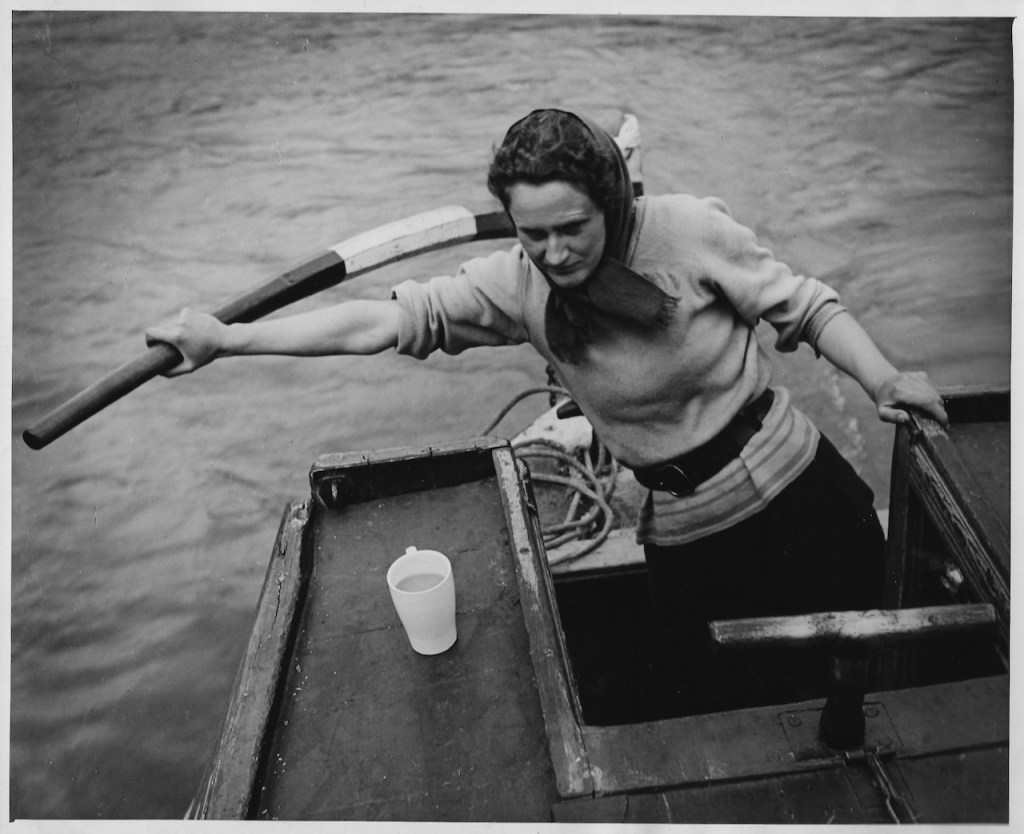
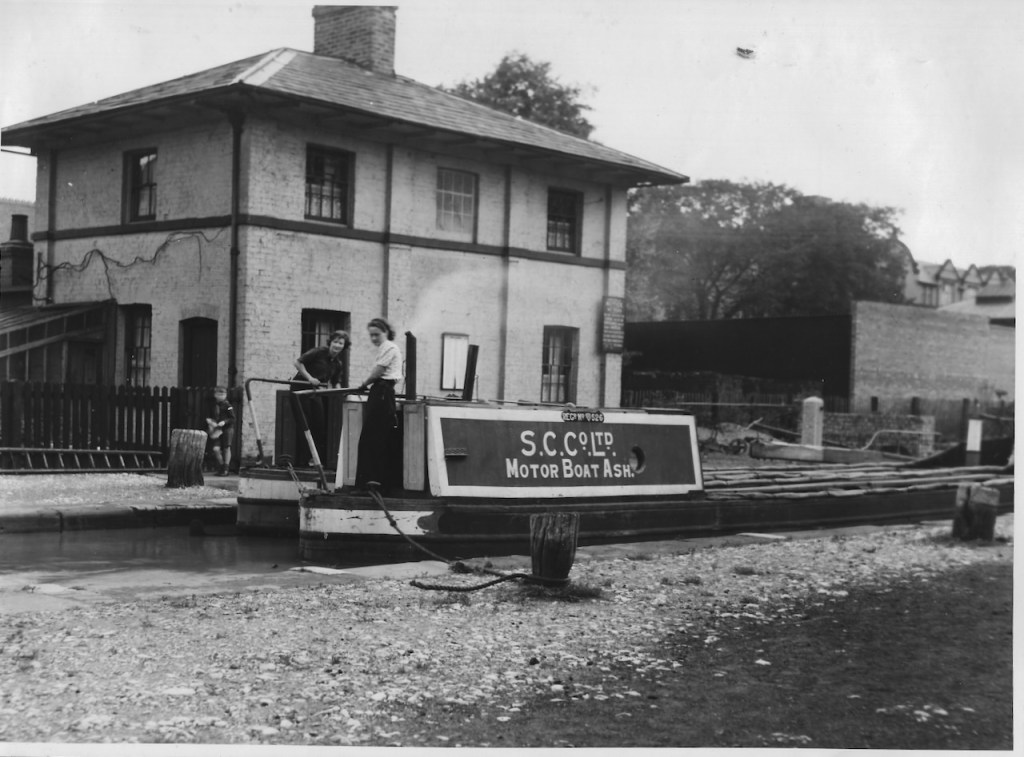
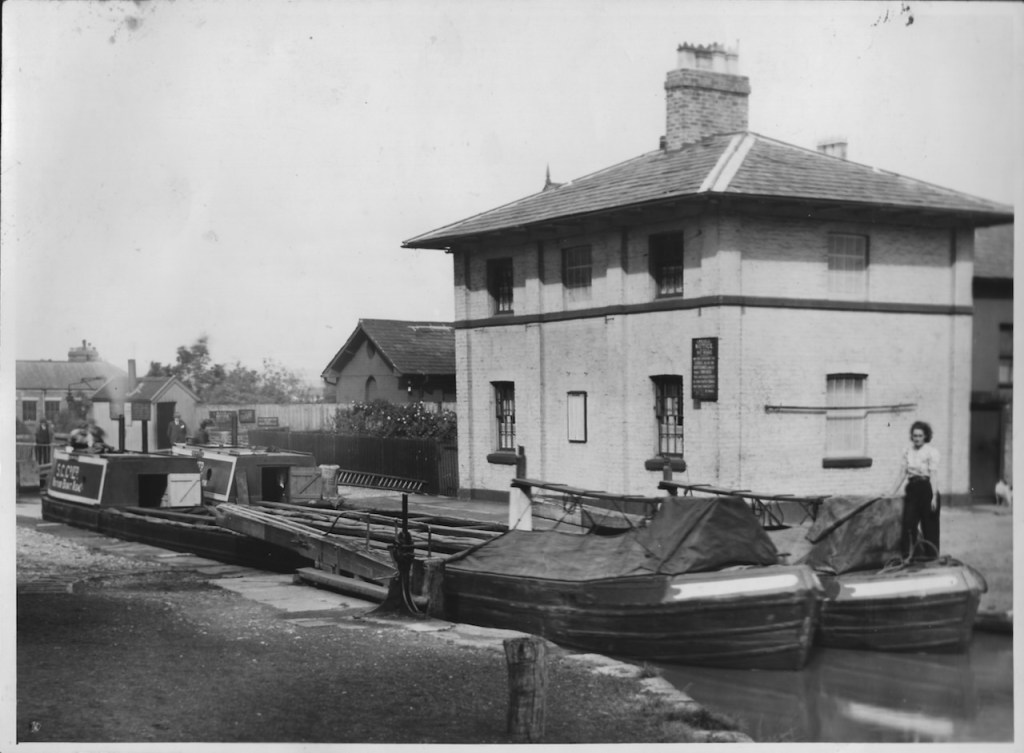
Ministry of War Transport publicity photo. [Copyright owner unknown]
This is the letter that prospective applicants to the Training Scheme would have received from the Grand Union Canal Carrying Co.:
From above “… you will be required to sign a simple form of agreement, a copy of which is attached hereto”:
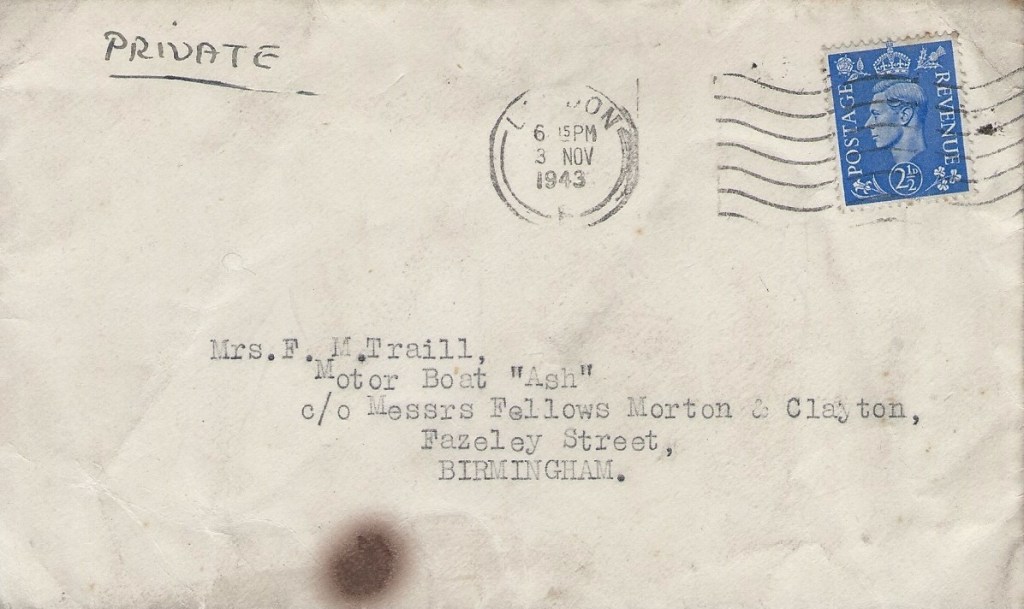
This would have been sent to the trainee shortly before commencing service:
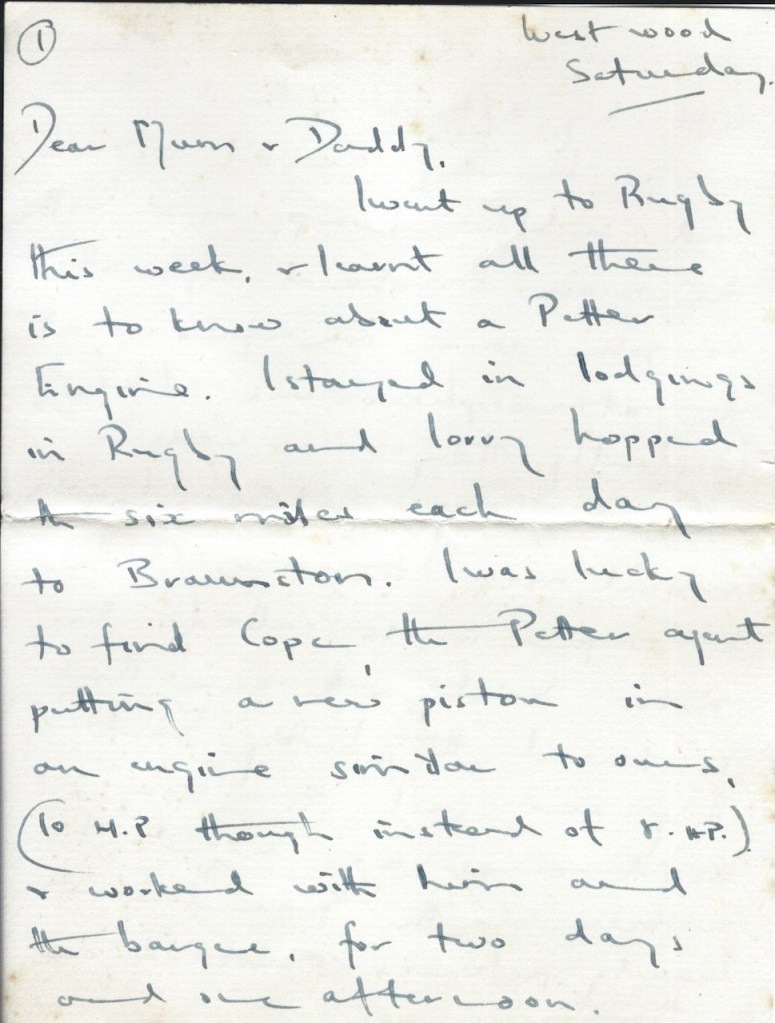
It is interesting to read above that “A certain amount of instruction will be given in the care and running of the engines, but it is emphasised that you are not required to be mechanics and repairs to engines are carried out by an experienced staff of fitters …”. Before joining Daphne March, Molly spent two and a half days at Braunston with Cope(?), the Petter agent, learning “all there is to know about a Petter engine”. See her letter home dated 8th February 1941. And in her letters she talks about doing repairs to engines herself on more than one occasion.
Website by Crispin Partridge – Grandson of Molly Traill.
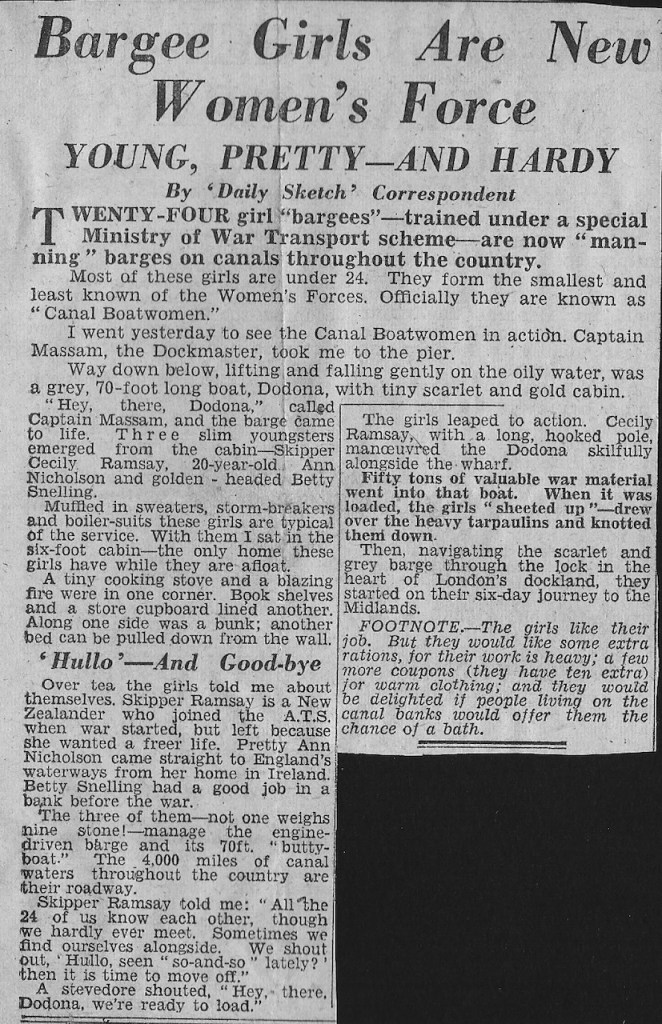
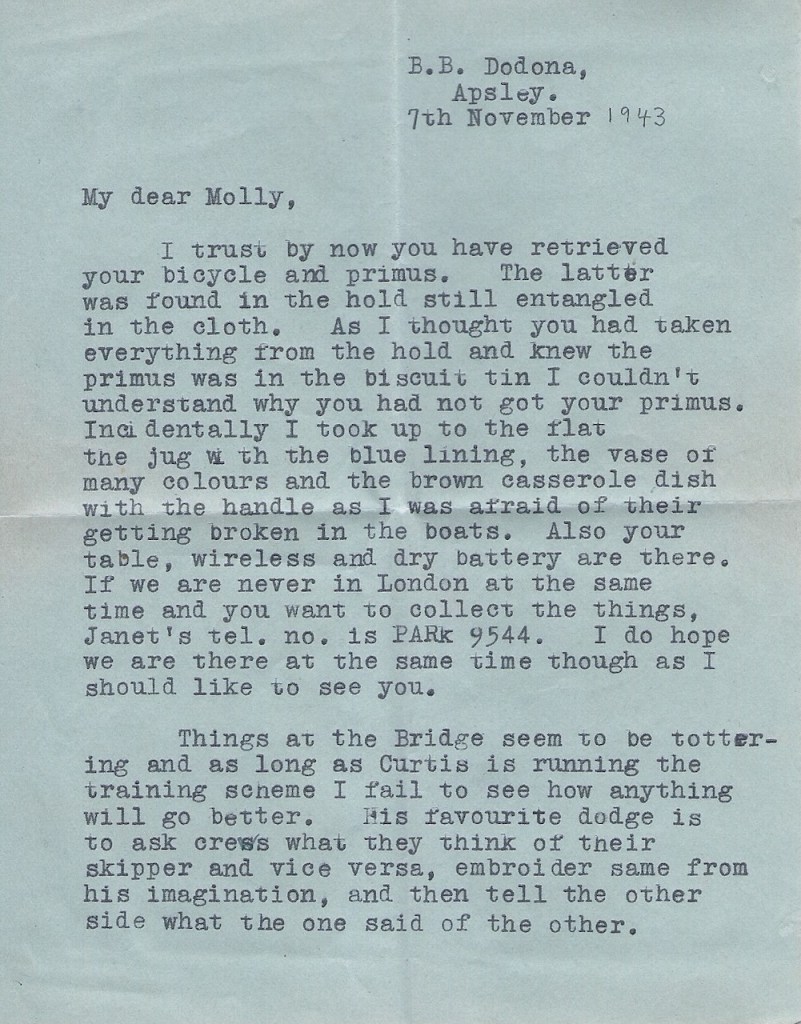
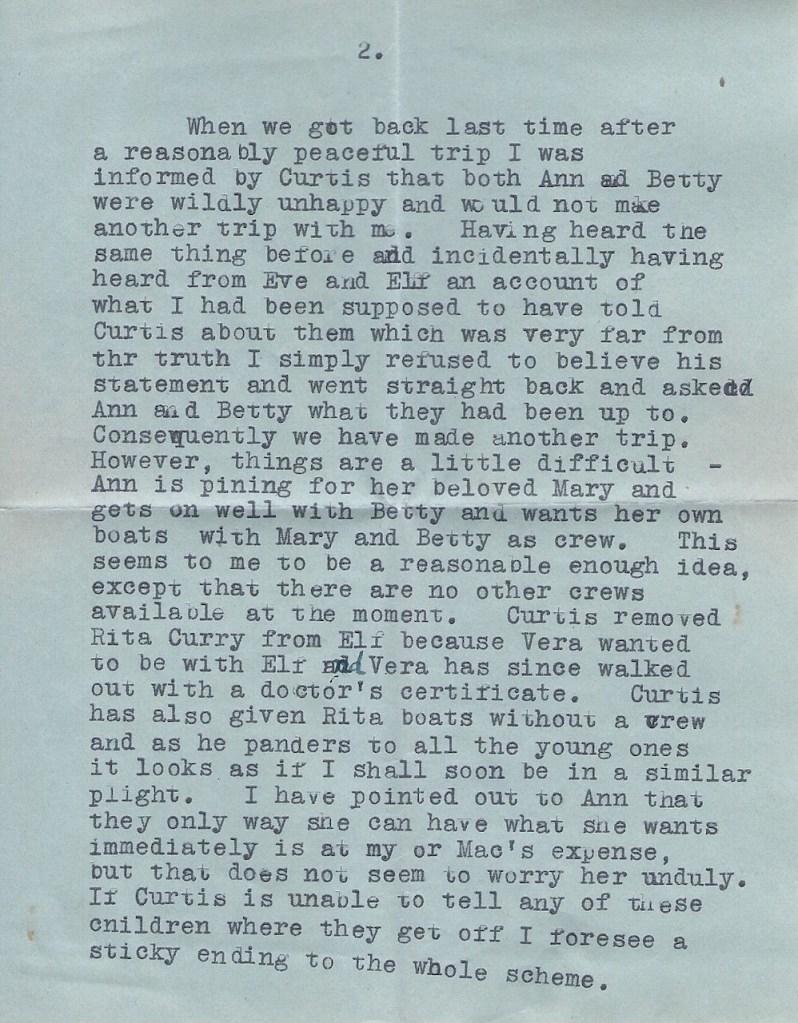
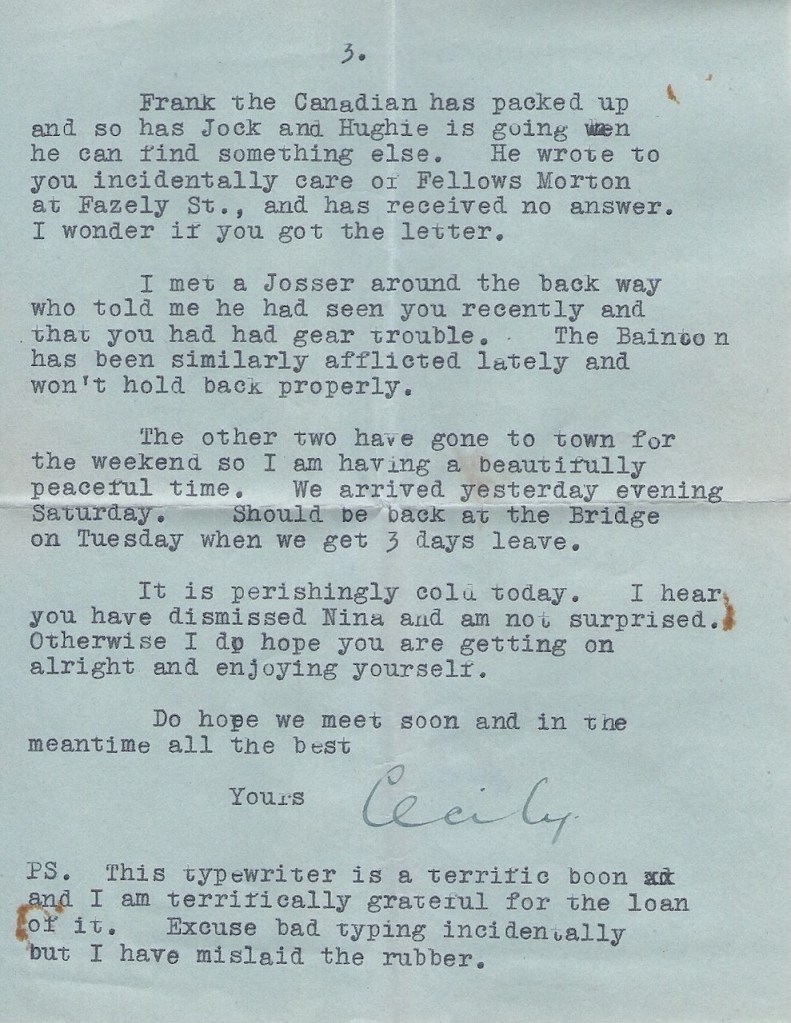
The following letter from Cecily Ramsay to Molly gives an insider view of the various characters involved in the Training Scheme at the end of 1943. It is quite a revealing account of the inter-personal dynamics and rivalries, and gives a very different perspective to the glamorous image of the young women portrayed in the Daily Sketch article above.
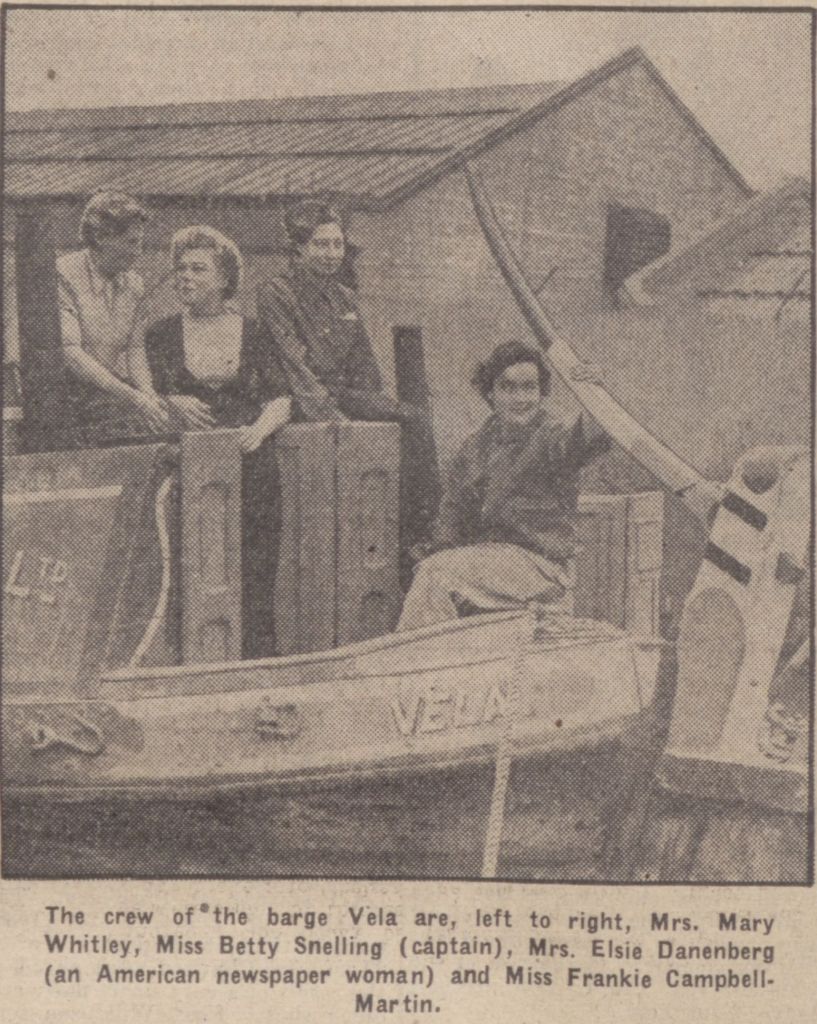
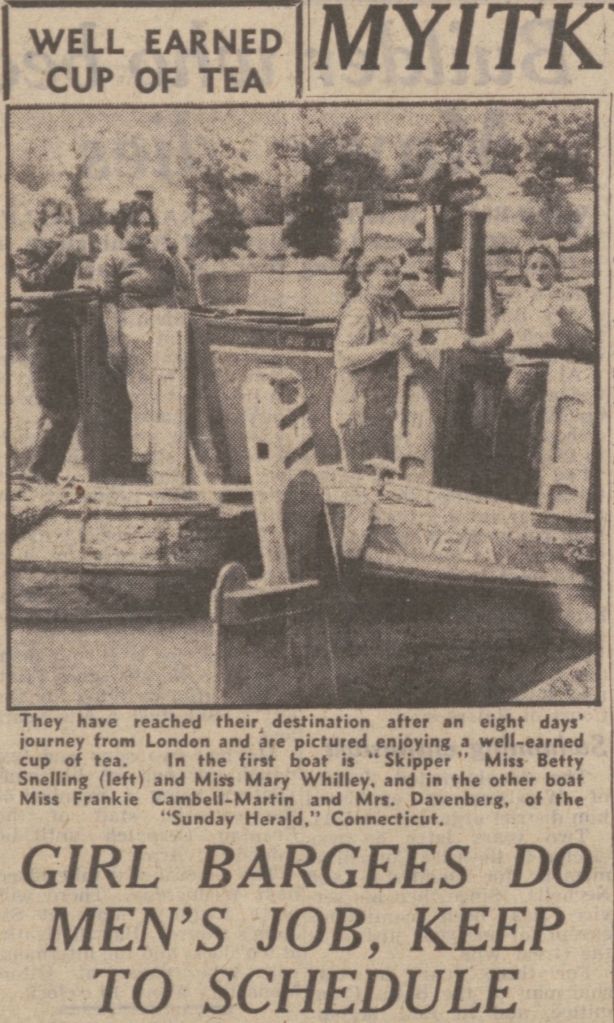
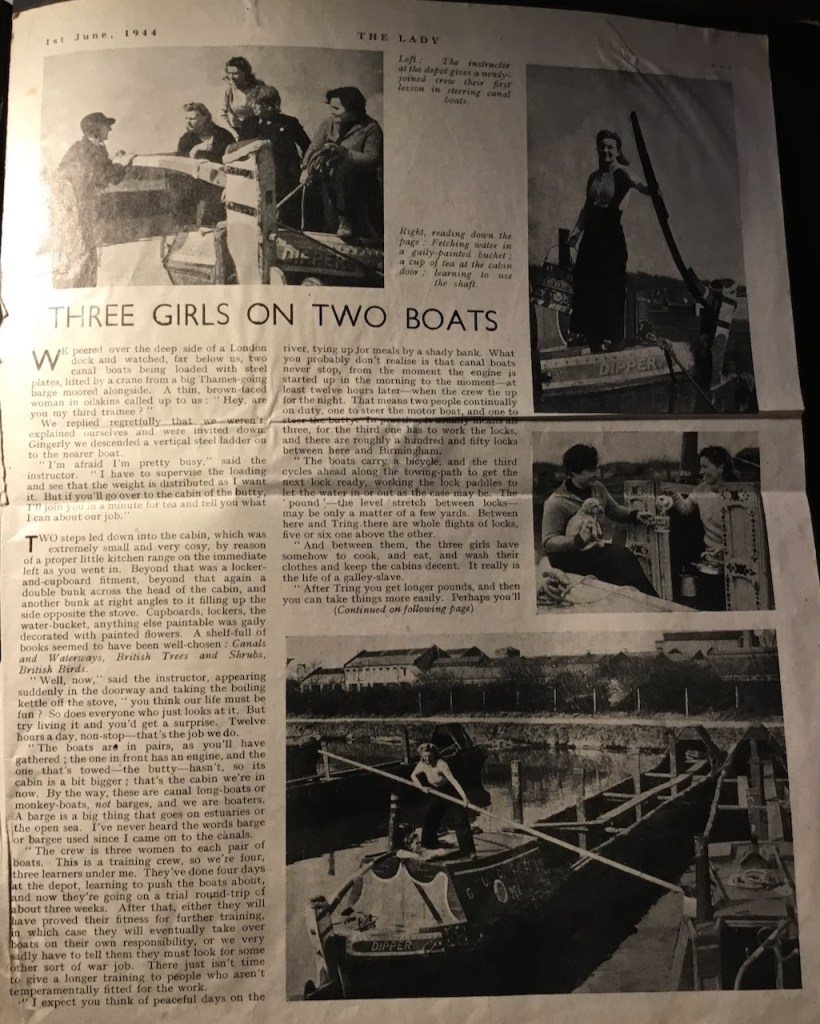
Two of the characters in the letter above, Betty Snelling and Mary Whitley, feature in the two following press photographs:
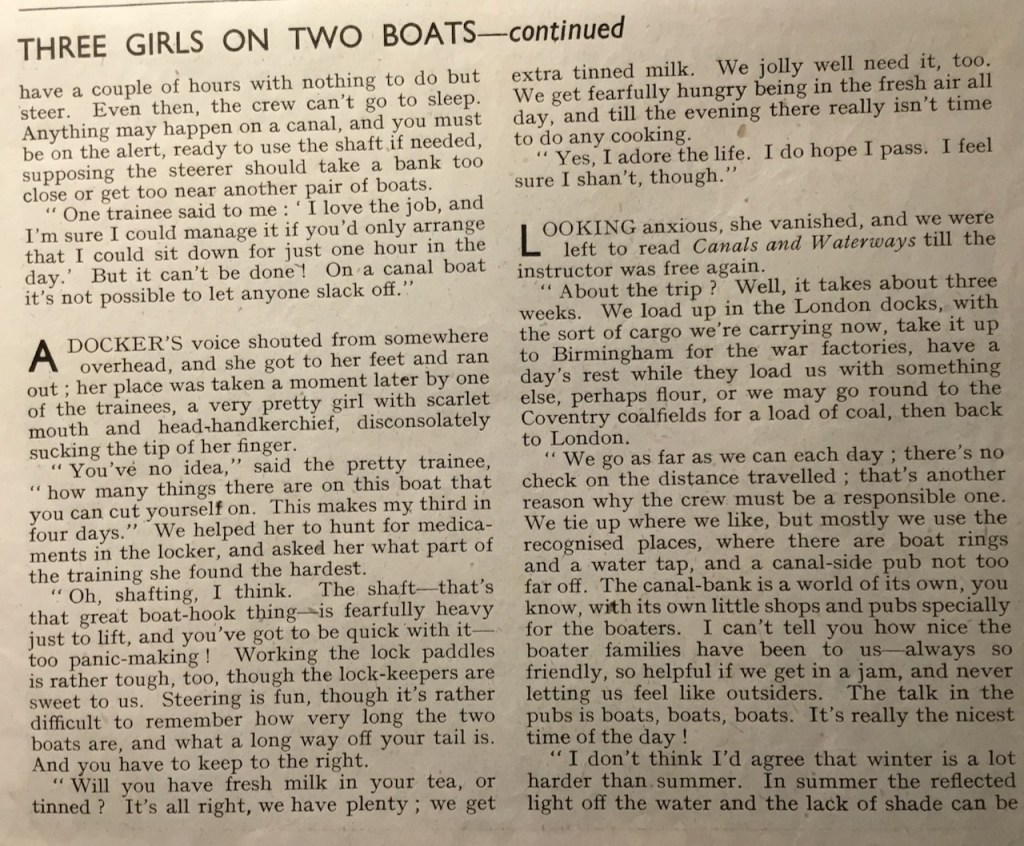
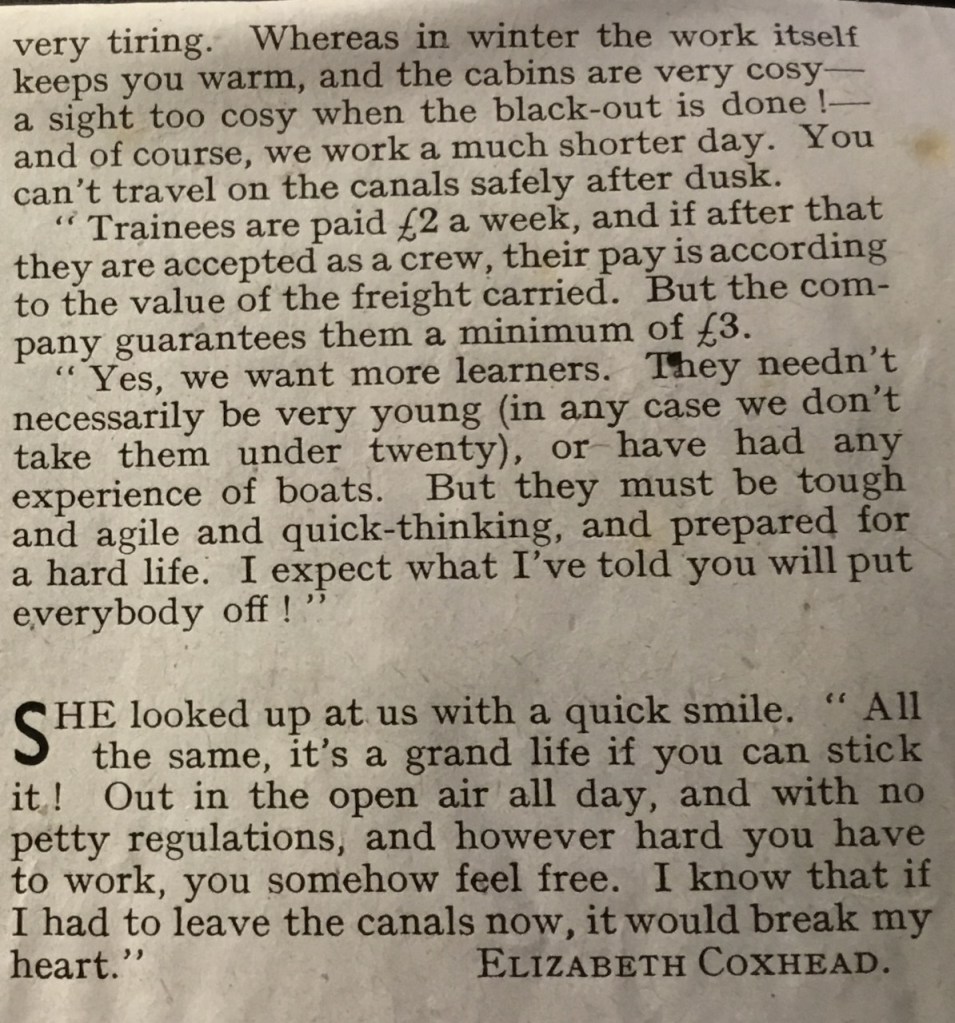
Birmingham Mail, 27 May 1944Evening Despatch, 27 May 1944The Lady, 1st June 1944
Cecily Ramsay, incidentally, gave several talks about her life during the war when she got back home to Dunedin, New Zealand. This short piece is from the [Dunedin] Evening Star, 3 October 1946:
The story of her experiences on a boat on the English canals during the war, trading between London and Birmingham, was the subject of an address given by Miss Cecily Ramsay to the Travel Club, which met in the Tudor Hall, Savoy, yesterday morning.
Website by Crispin Partridge – Grandson of Molly Traill.
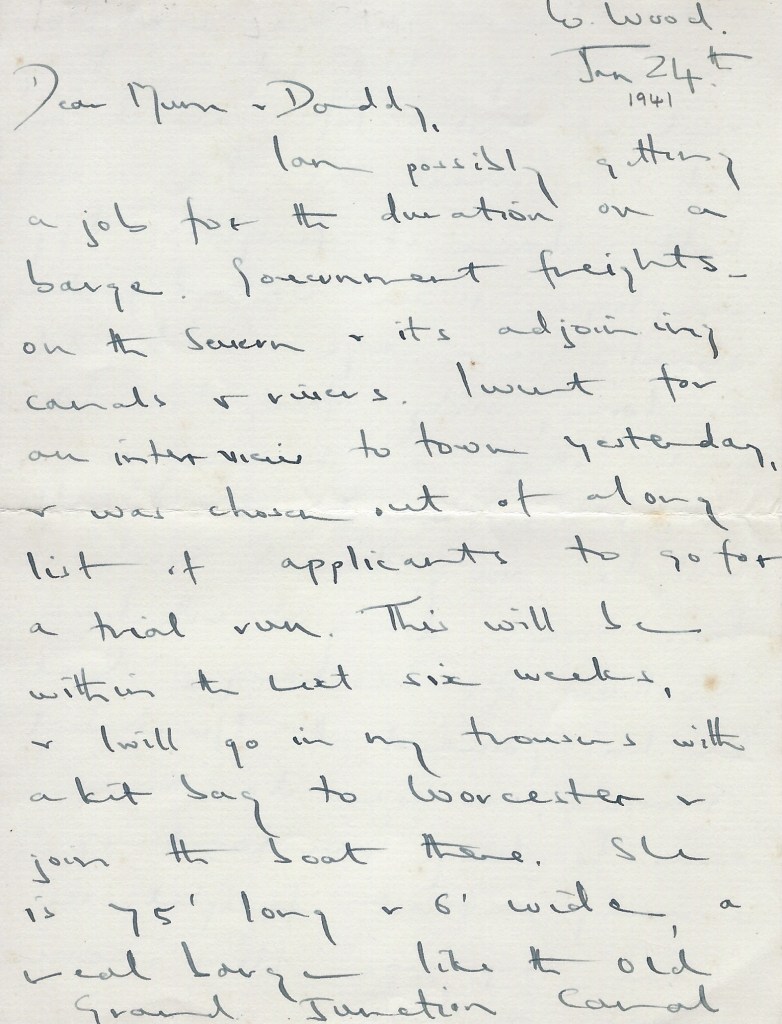
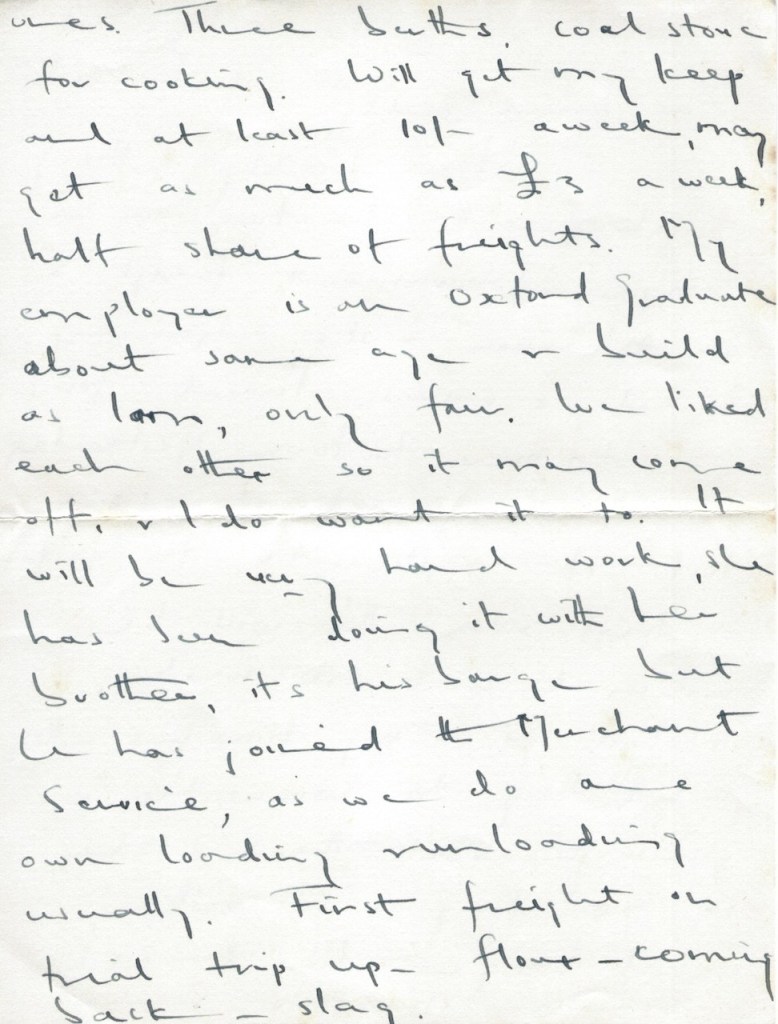
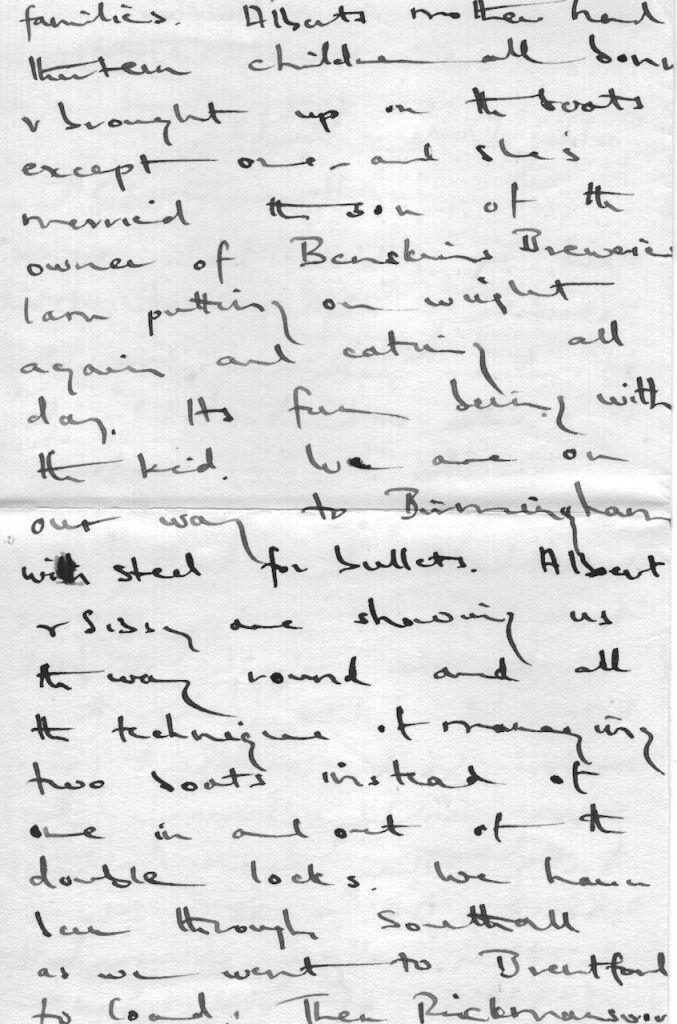
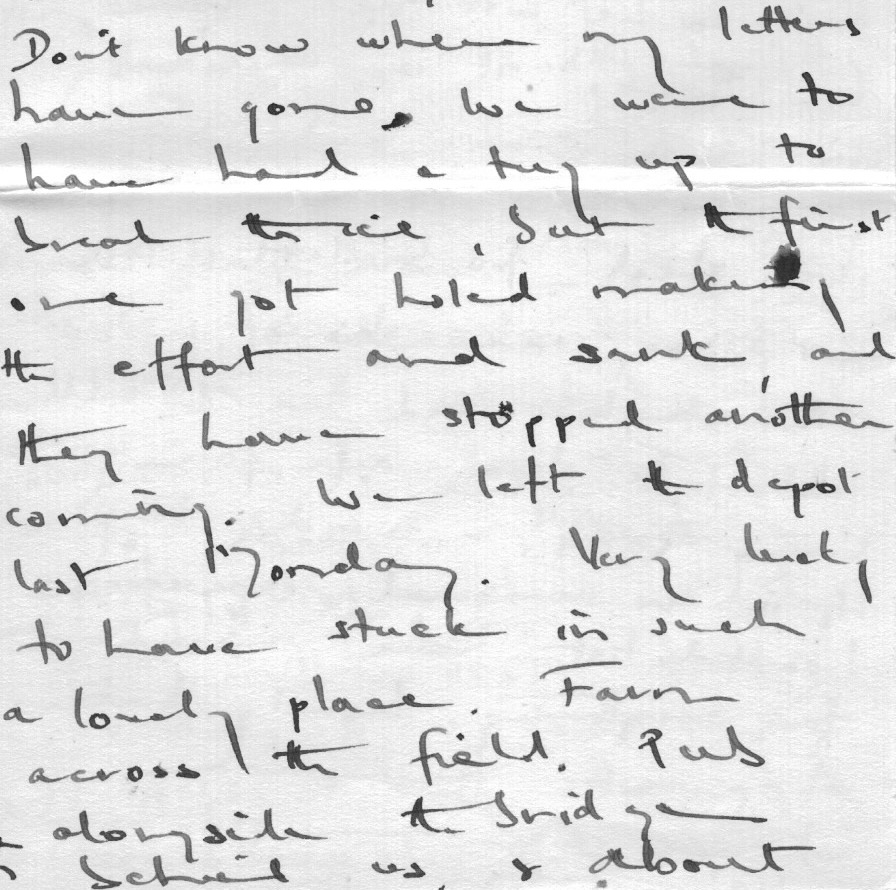
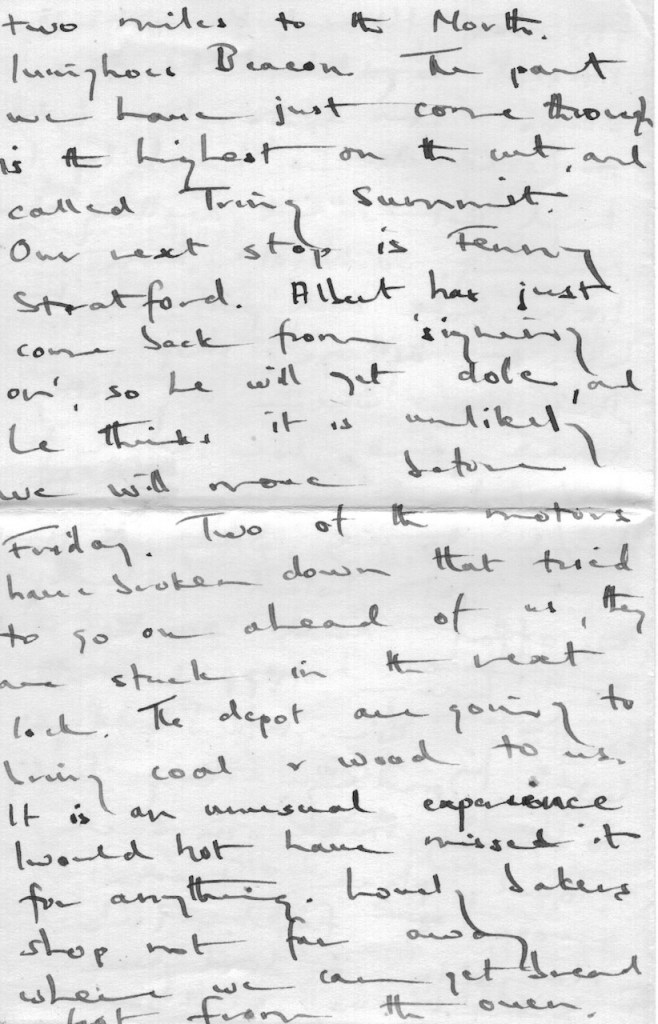
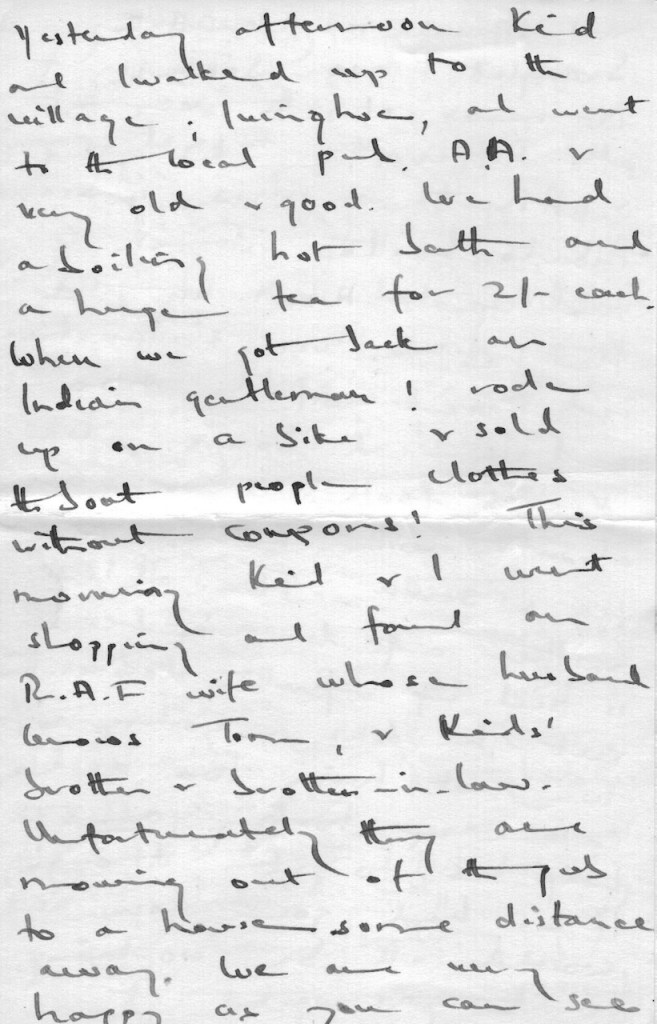
Here are extracts from some of the letters Molly sent to her parents about her application for the job with Daphne March and the skills she had to learn, before boarding the Heather Bell in 1941. Then the letters move to 1942 and the start of the Boatwomen Training Scheme.
By the time of the next letter she had learnt that it is a narrow boat, not a barge:
8th Feb 1941
A letter from the 17th February 1941 opens with:
No further news as to our movements except that the girl has had flu, & the 17th is today & I have not been summoned for the trial run.
Undated, but probably circa end of February 1941?????, and are generous to the last penny.
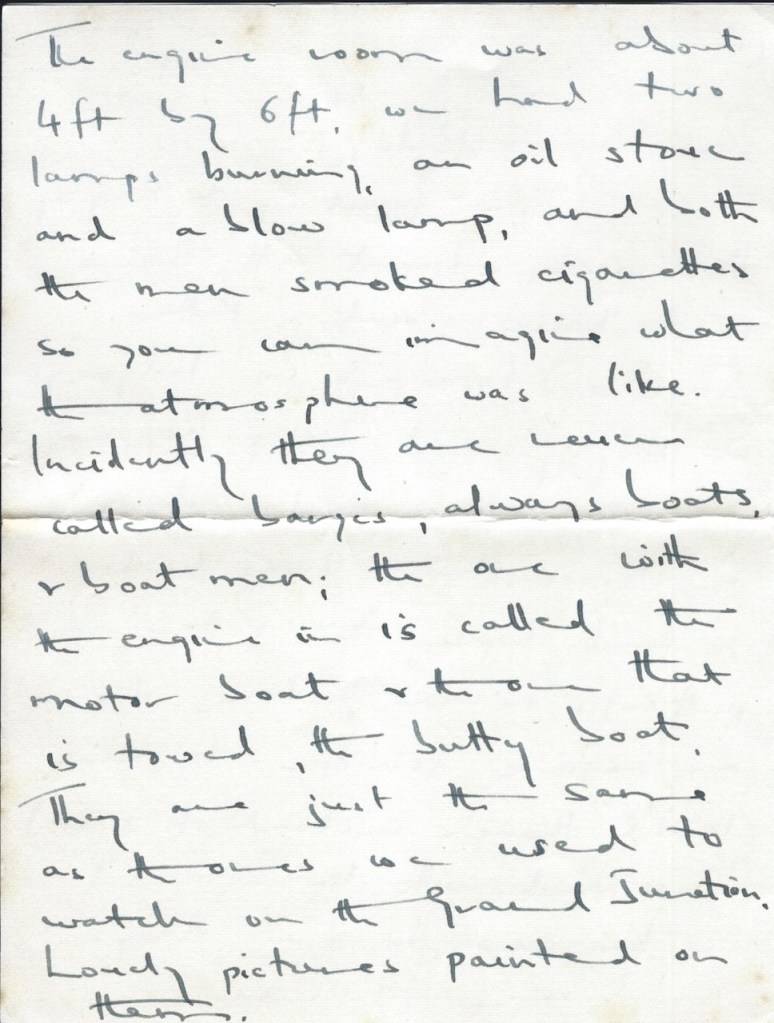
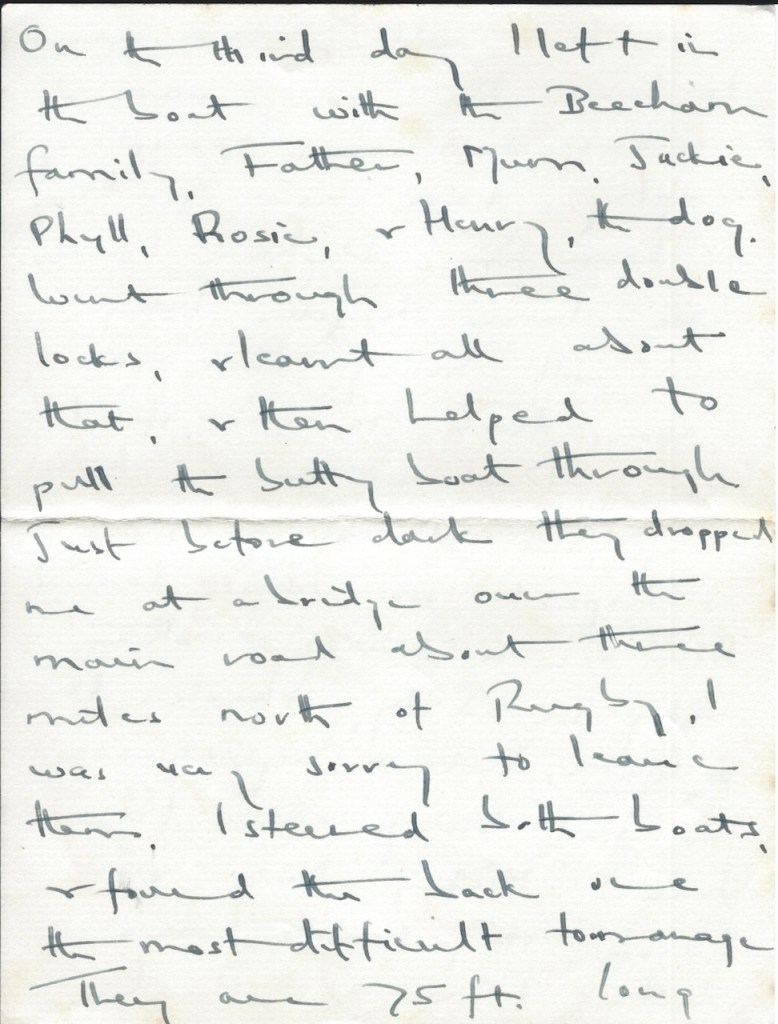
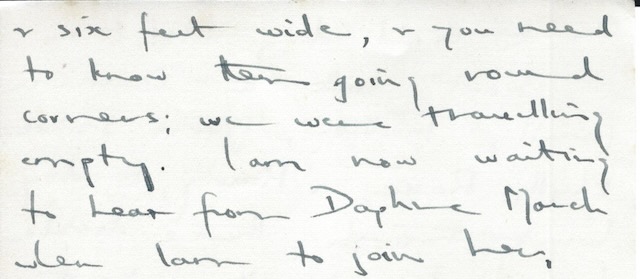
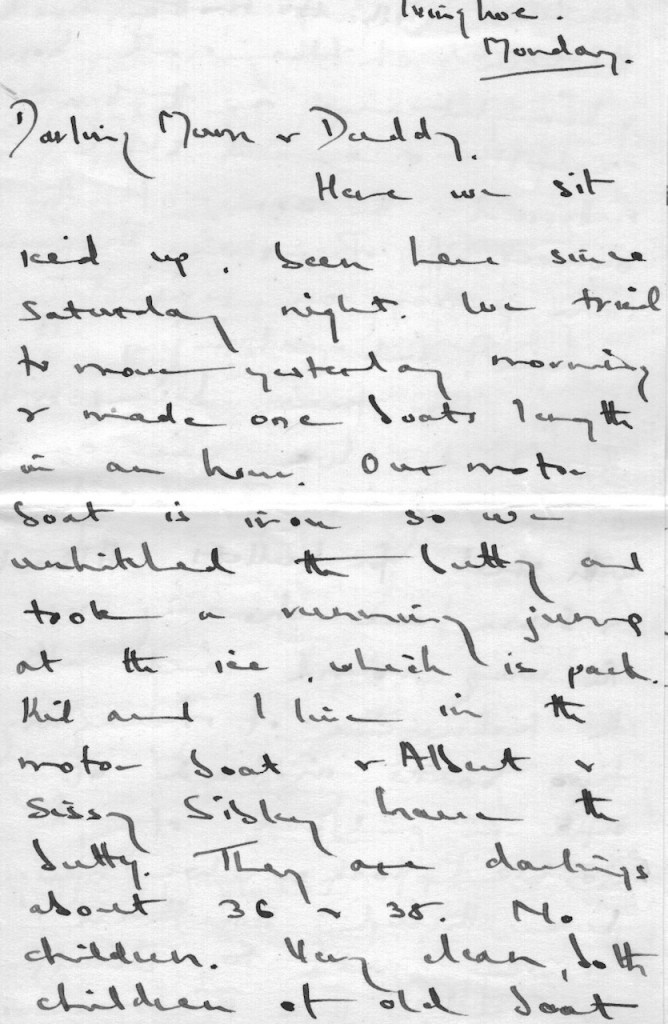
Much detail in this letter about the trip with the Sibleys, undated:
January 20th 1942 – Molly is itching to start training her first batch of women for the Boatwomen Training Scheme:
I have got digs in Southall, c/o Mrs. Hunter,
Undated, but probably 24th February 1942, six days before the first training trip:
This next letter is dated Easter Monday, possibly 6th April 1942:
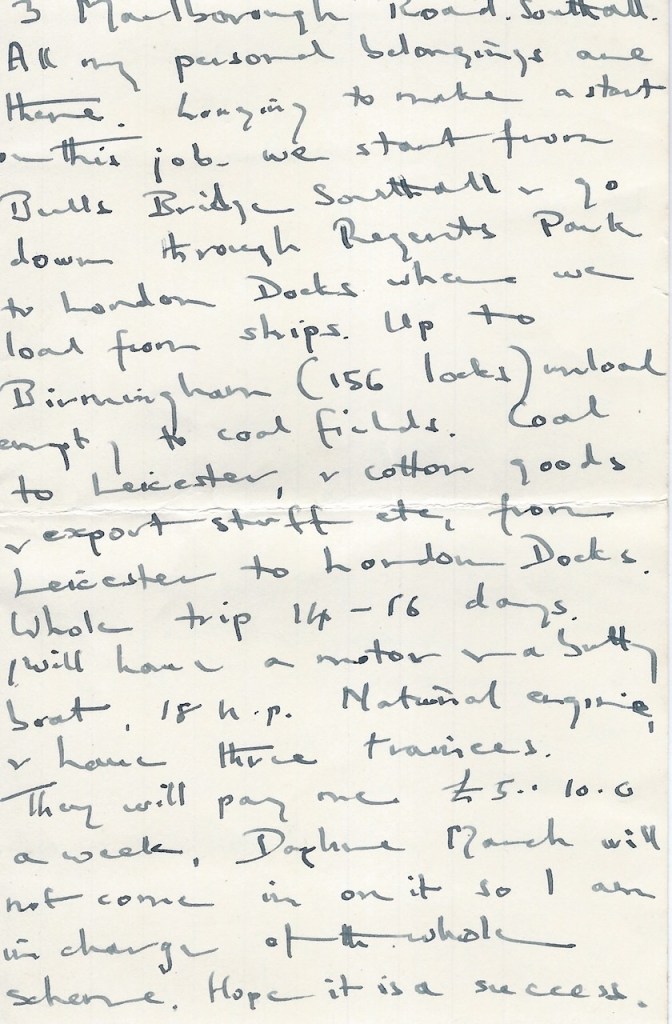
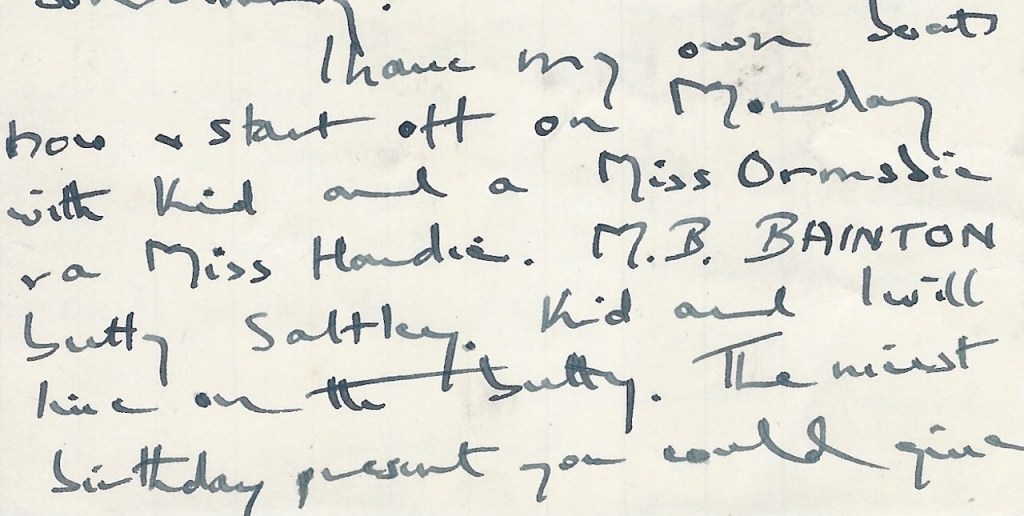
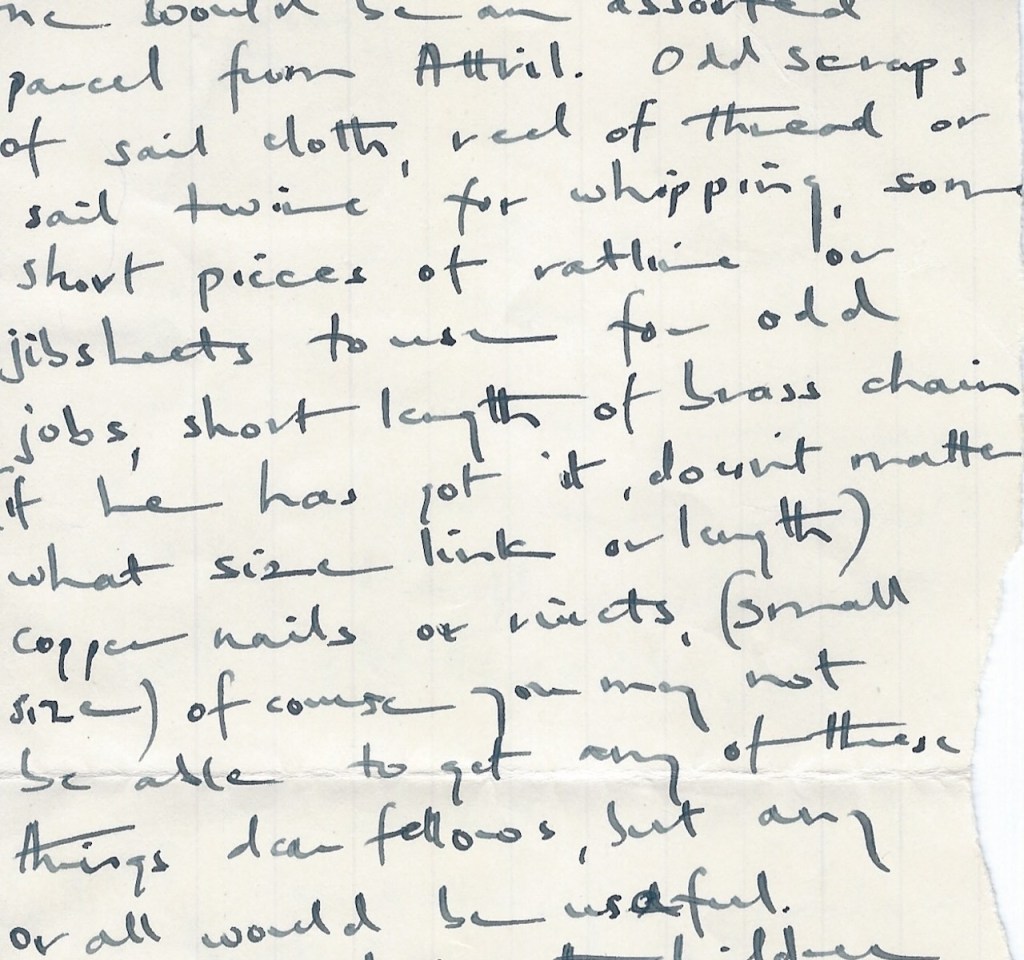
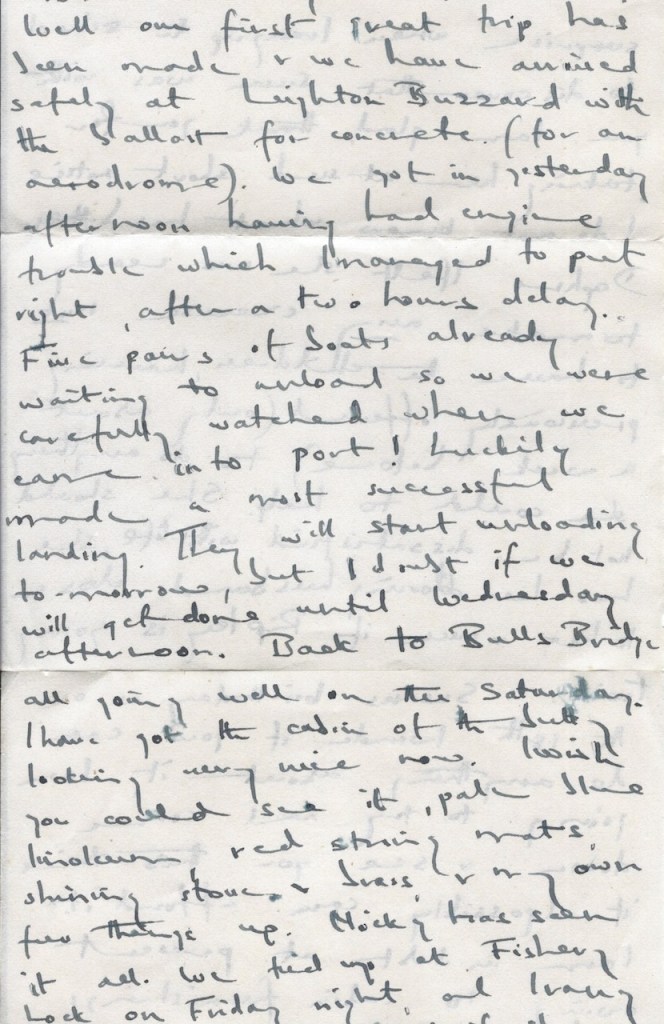
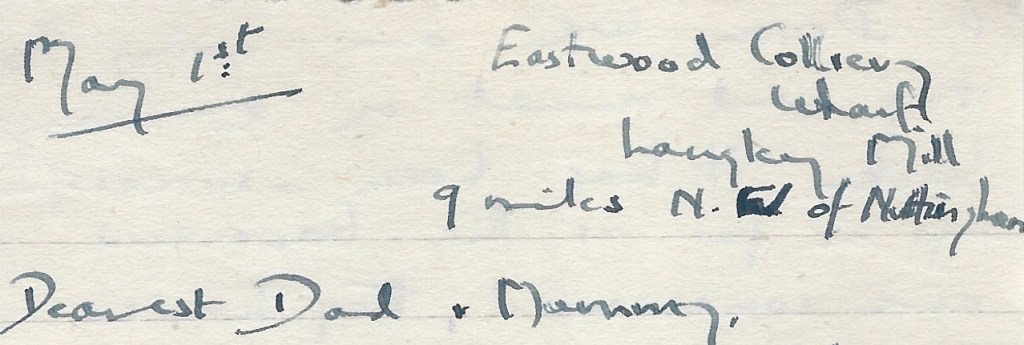
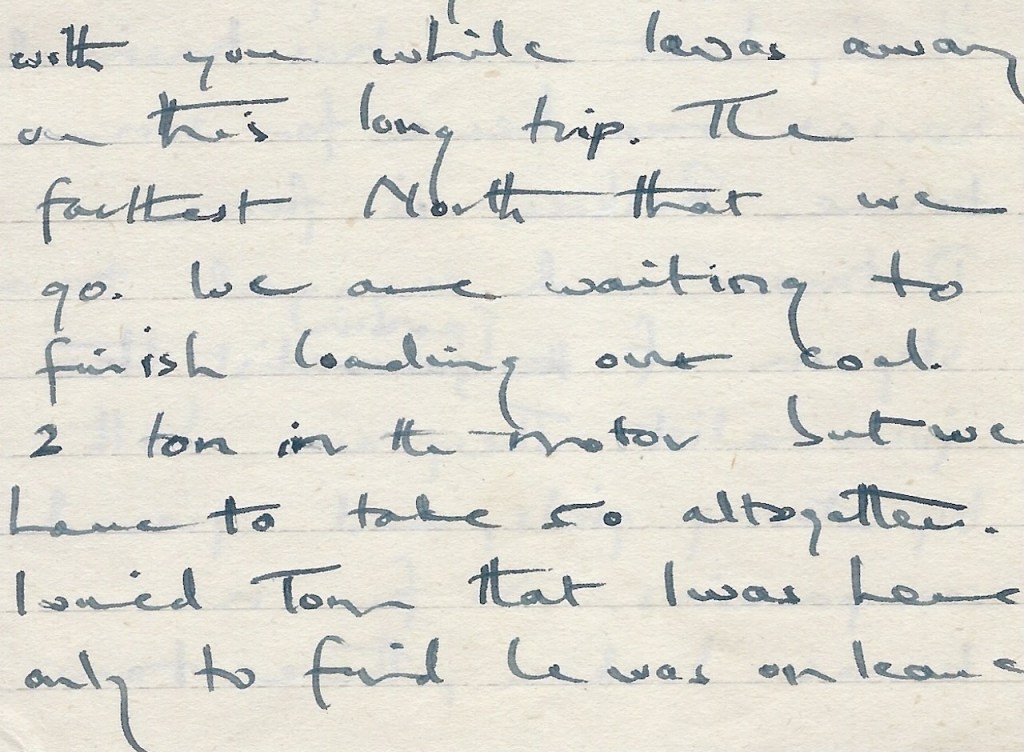
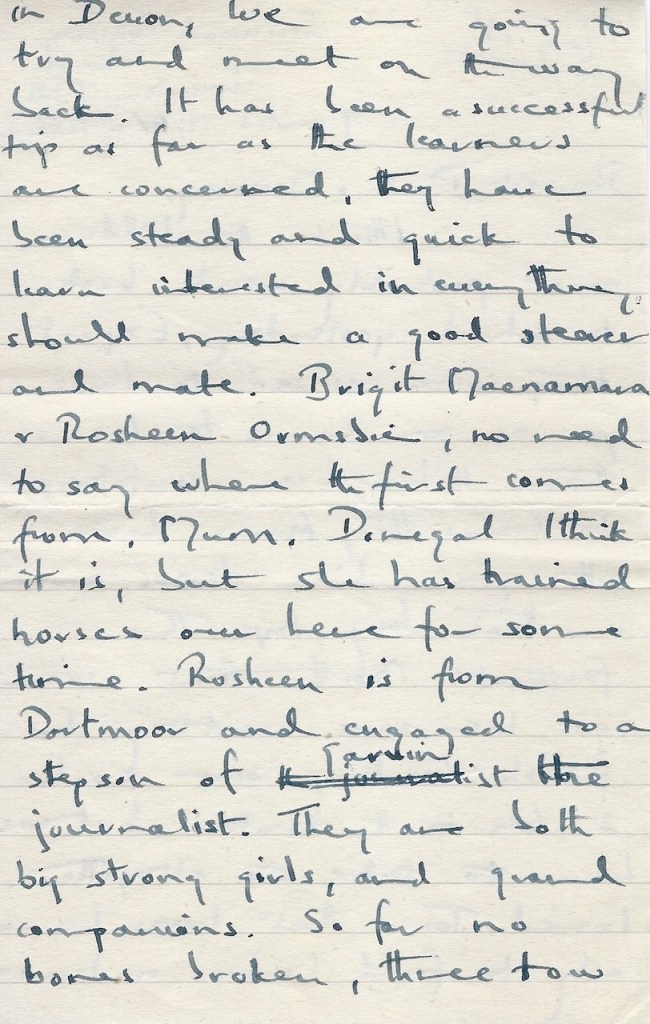
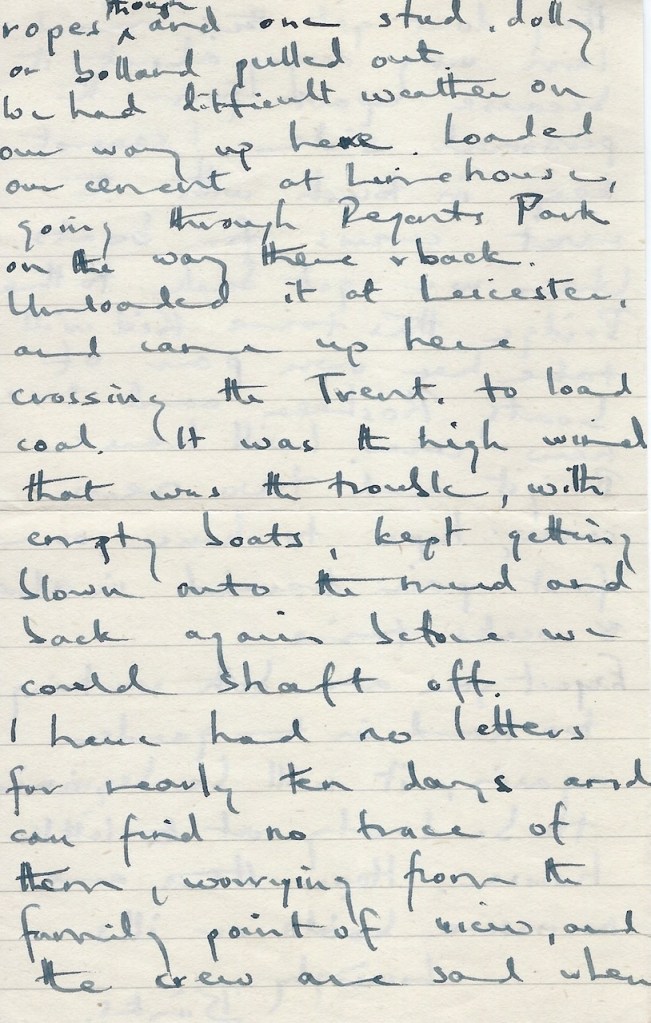
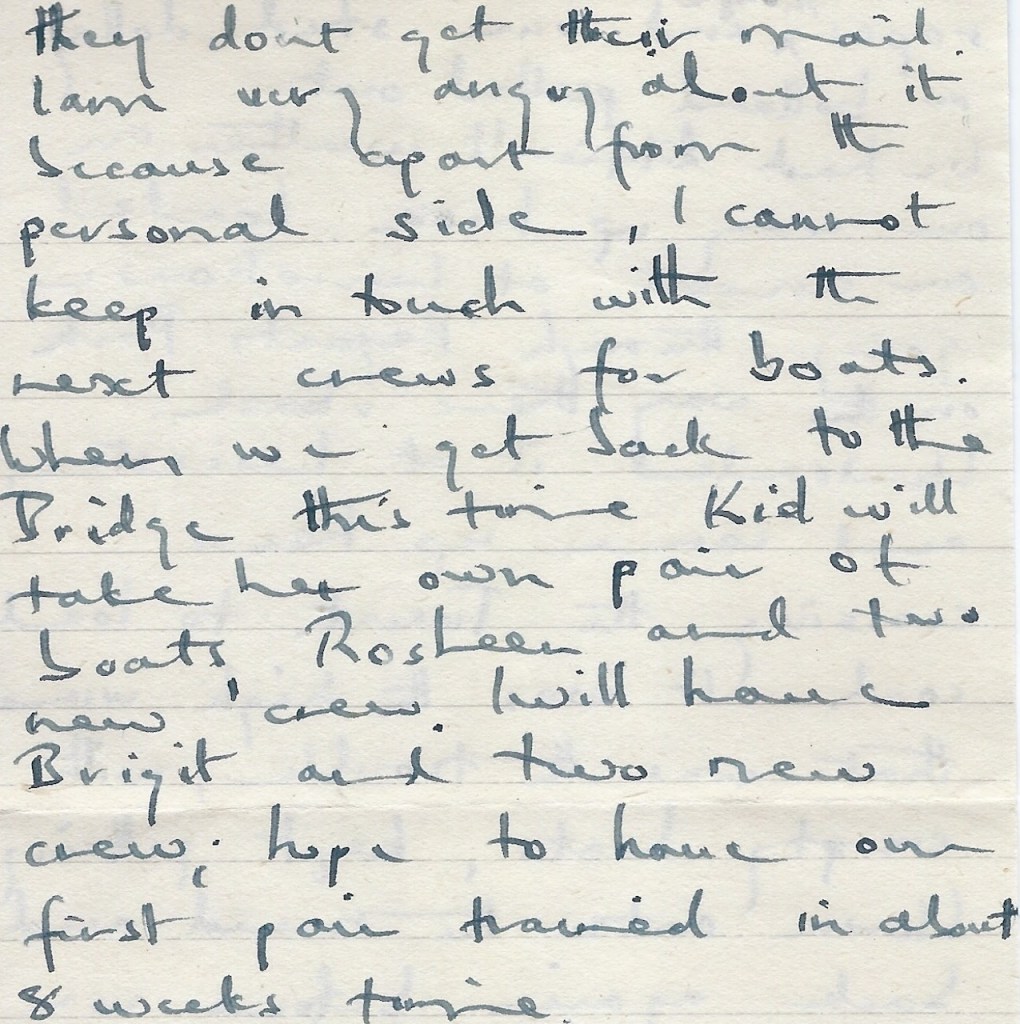
Her second trip started on 15th April 1942. This letter, dated 1st May 1942, was probably from this second trip:
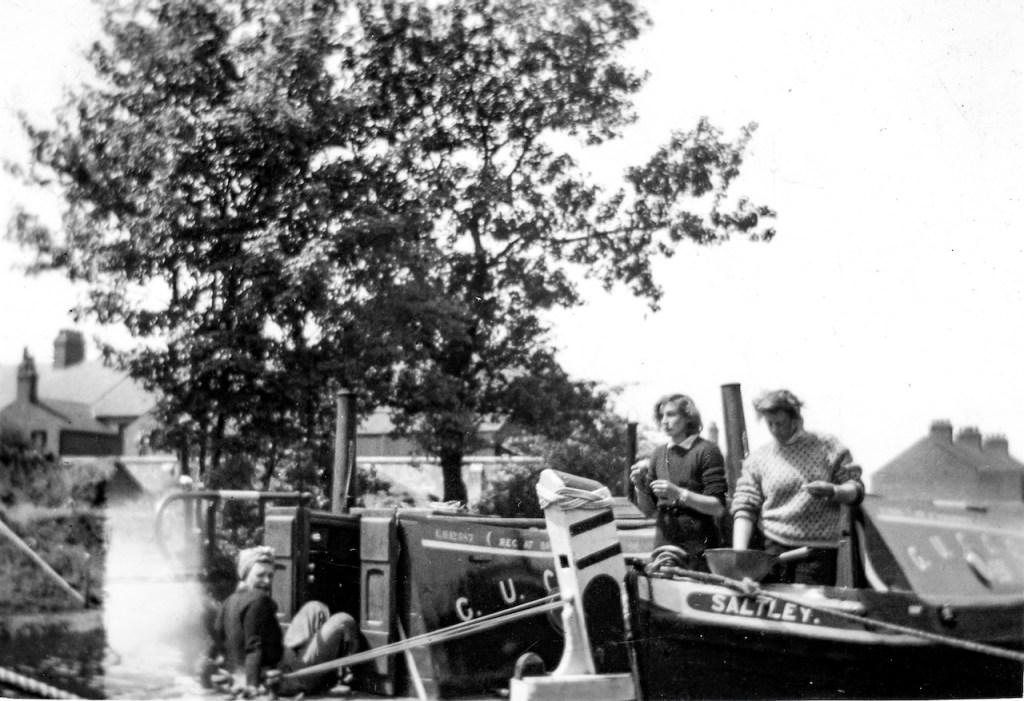
This photograph, courtesy of the Eily Gayford Archive [thanks to Mike Constable] is fairly certainly from the trip described in the letter above. Brigit Macnamara is on the right, on the butty Saltley. Molly Traill is standing next to her, and Rosheen Ormsby [we think] is pictured sitting on motor boat Bainton. Eily Gayford took the photograph. It is, incidentally, the only known photograph of Molly from the war period; there are none in her photo albums.
Copyright: Eily Gayford Archive
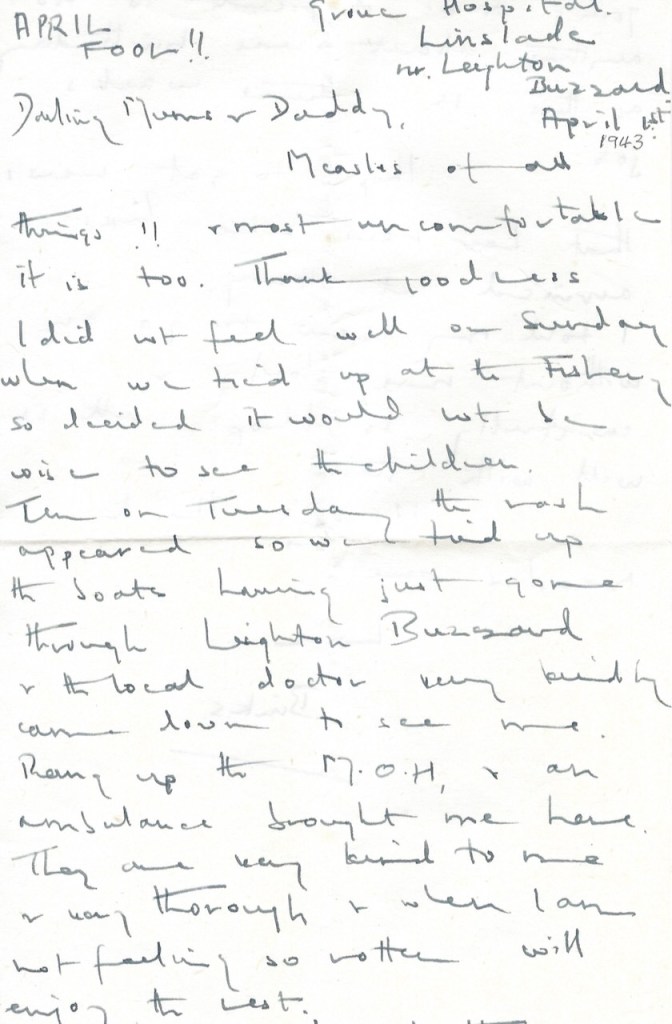
There follows a long gap in the correspondence to April 1st 1943 when, during a training trip, she is laid up with the measles:
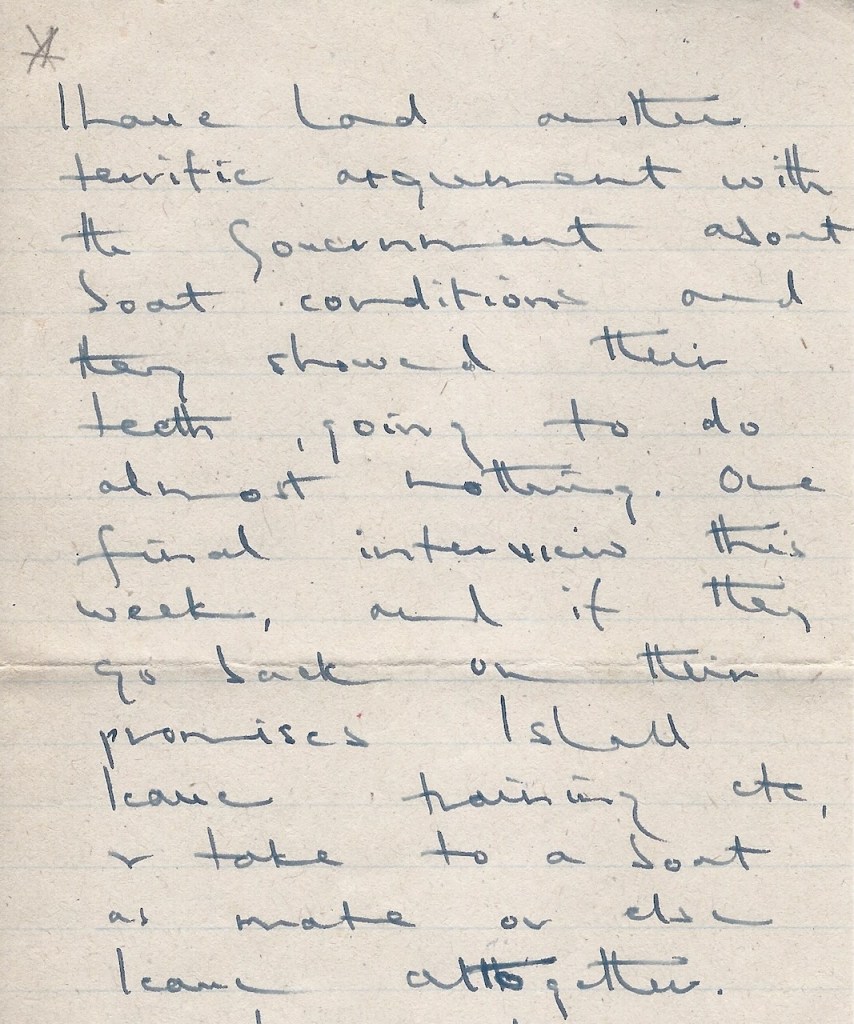
Another long gap to the final letter, 6th December 1943, around the time of her dismissal by Philip Noel Baker, Minister of War Transport. His letter was dated 29th November 1943, so perhaps a little more than a “terrific argument”:
Website by Crispin Partridge – Grandson of Molly Traill.
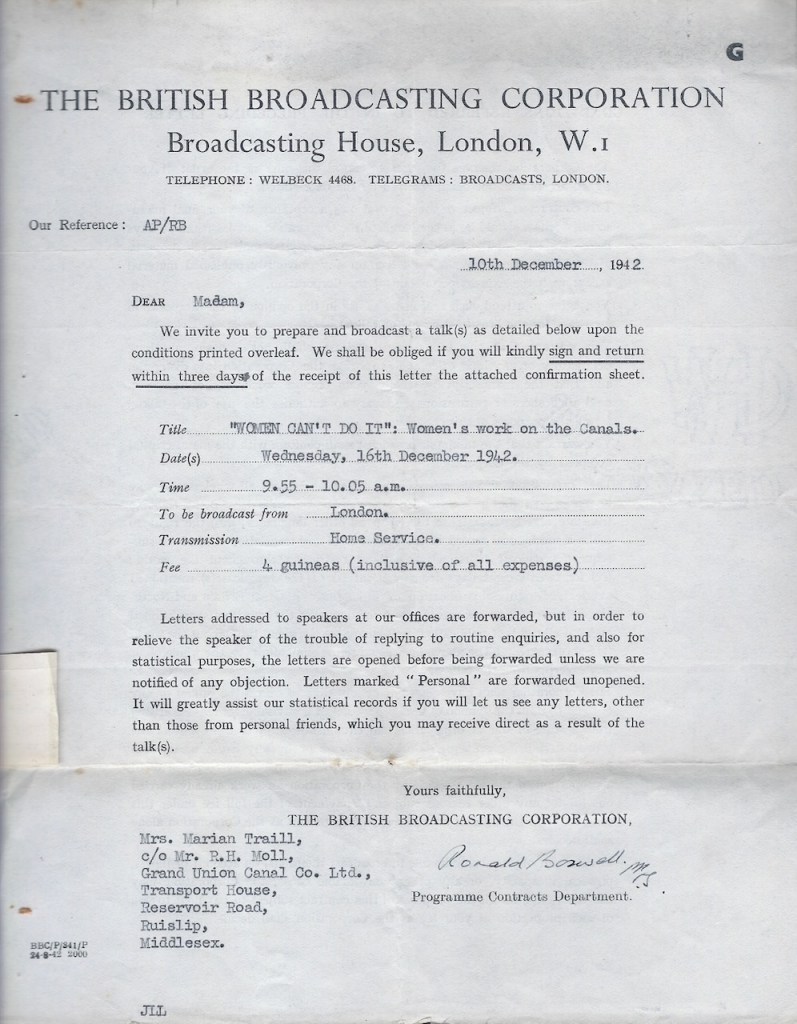
At the end of 1942 Molly was asked by the BBC to give a talk on the Home Service about women’s work on the canals, for the ‘Women Can’t Do It’ series.
This is the transcript:
WOMEN CAN’T DO IT
TWO CANAL BOATWOMEN – Mrs. Traill and Miss Ormsby
MRS. TRAILL: Women in this country aren’t encouraged to become captains of ships – yet – but they can be captains of canal boats, or ‘steerers’ as they’re called, and some of them are already.
At first, nobody thought that women could do this work. It’s tough and heavy; you have to be physically very fit and pretty strong, and you must enjoy an open-air life and not mind living in a cramped space. The boats work in pairs, manned by a crew of three. With the regular boater families, who’ve lived on the canals for generations, the crew consists of the steerer, his wife who acts as mate, and a boy – or the children – as lock-wheeler.
The new women recruits, who have been trained and are proficient, work in crews of three too, as a steerer, mate and lock-wheeler. All three must know their jobs and share the day’s work equally. We live, eat and sleep on the motor and the butty – by the way, the butty’s the boat that’s towed behind and has no engine, – and we have to have a thorough working knowledge of the ????teen horse-power diesel engine, of the locks, the Cut – that’s the canal, – of the loading and unloading points, and we have to be able to navigate properly.
The boats are known as narrow boats or monkey-boats: they’re seventy-one feet six long by seven feet wide and carry about fifty tons of cargo in the pair. The locks are double over the greater part of the Cut on which we operate, so that two boats can go in together. Before we get to a lock, the lock-wheeler has to jump ashore with her bicycle and cycle along the tow-path to the lock gates. Then she must draw the paddle with a windlass which opens the lock gates – this needs quite a lot of physical strength as well as skill – and then the steerer can steer the boats in.
An average day’s locking – as we call it – is about twenty and we take about six minutes to a lock, once it’s been made ready by the lock-wheeler. In some parts of the Cut there is continuous locking, which is rather a strain, especially on the newcomers to the job, but there are also long distances between the locks – incidentally we call these pounds – maybe of ten, fifteen or twenty miles, and then we can settle down and do a few domestic jobs like spring-cleaning and washing clothes, not to speak of preparing the dinner.
In training the new recruits I find that steering both motor and butty into the locks is one of the hardest jobs that they have to learn, as the depth and pull and flow of the water is different in each one. The boater knows these things from his childhood, but the women crews try to acquire this skill in a few weeks. You have to learn how to bring the boats in at just the right speed: if you go too fast, you won’t be able to stop the motor bumping by reversing her; and if you go too slowly the butty won’t come in of its own accord, but will have to be pulled in by hand.
Speed is very essential in getting cargoes to their destination, and we work on freight rates – that’s to say we’re paid by the amount of cargo we carry. Incidentally, fragile cargoes are carried more easily in these boats than by any other form of transport, and you’d be astonished, I think, if you knew how much valuable war material is actually transported on the canals these days.
When you see a pair of boats on the canal with tarpaulins over their cargo, it may interest you to know that they may be full of wheat or cement or steel or coal, etc., etc. I’ll leave you, Rosheen, as you are actually operating boats, to talk about the loading and unloading of the cargoes.
But first, listeners would probably like to know how we live on these narrow boats with their brightly painted bows and stern and their shining brass rails and fittings. The cabins are about seven feet by six feet and have a double bed in them which folds up during the day, and a small side bed. There’s very little floor space, as there’s a table, cupboard and small coal stove. We cook on the stove and boil innumerable kettles for washing and tea, and I’ve always found them extremely efficient and warm. Lighting is from batteries which are charged by a dynamo running from the engine. There are two cabins, of course, one on the motor and one on the butty. On the motor we stow our food in a cool locker under the stern, and in the butty, in a cupboard under the hatches. We have emergency ration cards and buy our provisions at shops alongside the Cut, where the shopkeepers are used to serving us in a hurry – in fact, while the lock is filling, as we grudge every moment which delays our journey. By the way, we have a special permit for tinned milk. The trip I take lasts three weeks, and we’re able to get fresh milk several times en route; otherwise we use tinned milk.
When we women first came on to the Cut, the regular boaters looked at us rather askance. I think they thought we could never do the job. But when they found we were friendly and laughed about our mistakes, they soon grew friendly and helpful themselves, and we’re all on very good terms with each other. Now we have friends all along the Cut and a different tie-up every night,, meeting boating families we haven’t seen for many weeks and exchanging boat gossip – in fact, the whole life is boats, boats, boats, nothing but boats; not just messing about, but vital, needed work, water transport which has a great future. Apart from this, I do it because I like it. What about you, Rosheen? You like boats too, don’t you? Or are you only doing it because it’s a useful war job?
MISS ORMSBY: Well, yes, I do like boats. You have to, or you certainly wouldn’t stick this job. It’s hard work and I hate getting up early in the morning and going out when it’s very cold. You were running boats during the ice last winter, weren’t you?
MRS. TRAILL: Yes, I was. But I don’t mind cold or getting up early. It’s just part of the day. I’m used to it now.
MISS ORMSBY: For the first few weeks I thought I’d never learn this job – but, being determined, I went on with it and now it’s beginning to come naturally. It’s a question of feeling your way into it. You can only hope to learn gradually and by making many mistakes. Steering both the motor and the butty is difficult at first, as each has a different technique. I’m afraid I used to run on the mud and get stuck at first, but that doesn’t often happen now.
I will tell you about the routine of a trip, as it may give some idea of just what the work means. When we get back to our main depot, our boats are checked by the company’s maintenance staff and the engine’s overhauled. Then we get our orders and go at once to the next loading point, which might perhaps be at the docks. There we go alongside an import steamer and take the cargo on board. We are not expected to load the cargo ourselves, stevedores do this, although we are expected to help in stowing some cargoes. Normally we don’t unload our cargoes either, as there’s staff provided for this.
As soon as the boats are loaded we have to sheet them up, or cloth them up as it is sometimes called. This takes some time and must be done very carefully and efficiently or the cargo will get wet and damaged. We cover it with tarpaulins: what looks like forests of string and wood have all to be fitted into the right place and tied up properly with all the proper knots.
Then we leave the docks and start our journey. At night-time we try and get to a proper tying-up place and stay there, going to bed early, as we are usually very tired and have to start off again the next morning well before daylight. The days now are so short that we often have to run by night in order to make a good trip. We can choose when we do this and on our boats we usually prefer to run very early in the morning. All day long we’re busy, steering, lock-wheeling, cleaning out cabins, looking after the engine, cooking, doing our washing …
I found steering a great physical and mental strain at first. Sometimes you may go through many locks in a day and the paddles – as the sluices are called – are often very stiff to work, and then you are always running about and jumping out at locks, and you’re always in a hurry. Not only must you do a good day’s run, but there may be a pair of boats behind, and you don’t want to hinder them, and you certainly don’t want them to pass you!
For the beginner there seem to be lots of obstacles on the route, like low bridges, and emergencies, such as meeting other boats when you are just going round an awkward bend. If there’s a breakdown on the trip you can get hold of mechanics and fitters at different points on the route.
At first, I minded not having a bath, but now we have found out certain places where we can get them. We carry drinking water in two four-gallon cans on the cabin top of the butty and the motor, and there are taps at many of the tie-ups; but we use Cut water for everything else, except cooking. We fit out the cabin as we like, and although they seem very cramped at first, I have got quite used to living in such a small space and now find it very comfortable.
Our chief aim is to copy the boat people as much as we possibly can, although it seems hopeless that we can ever work so fast or well as them. But they have been so kind in showing us what to do and helping us out of trouble – in fact we could not have got on without their help. Their cabins too are magnificent, spotlessly clean and full of shining brass and china. The boaters keep themselves very separate from the shore people. They’re particularly proud of their sons, and as soon as a little boy is more than a baby, he is proudly set to steering.
Well, finally we arrive at our destination. The boats are unloaded by cranes, and we go off to our next loading place. We may have taken a cargo of cement on the out-going journey and then we bring a cargo of coal home. When this is unloaded, we go back to the depot, ready to start off again; and if we’re lucky, we may get a short break before our next trip.
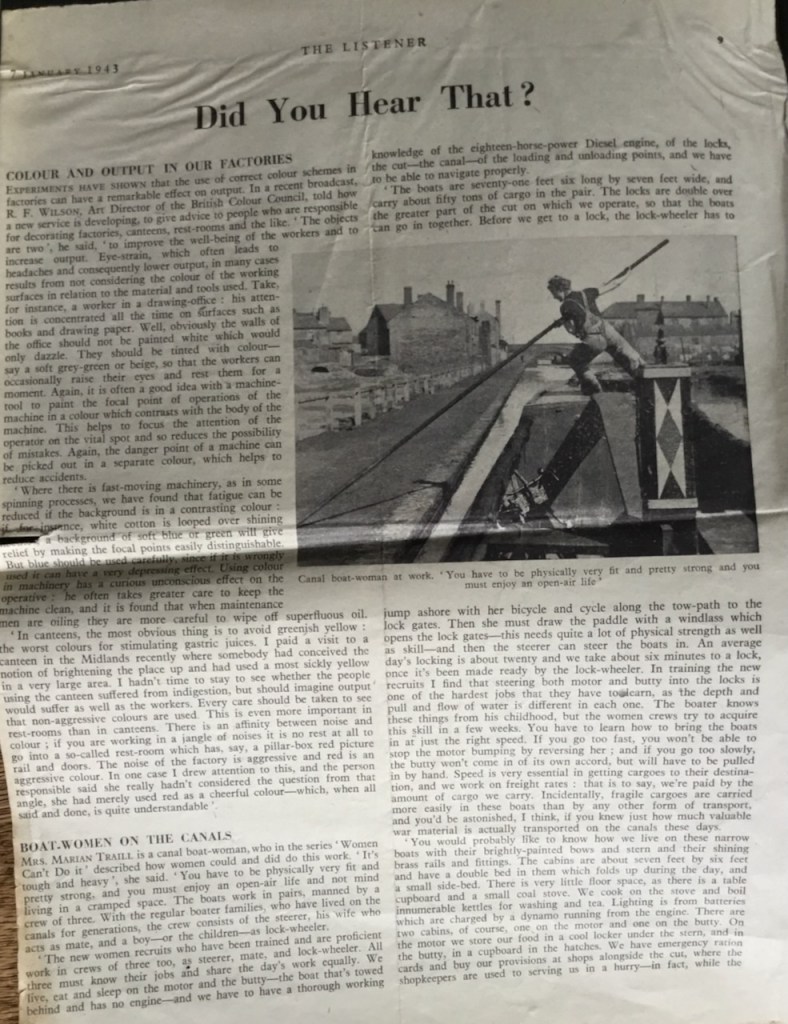
The Listener did a short piece on the talk as part of its ‘Did you hear that?’ series – 7th January 1943. It is an edited extract of the transcript above. As such, the first page only is shown below, for illustrative purposes.
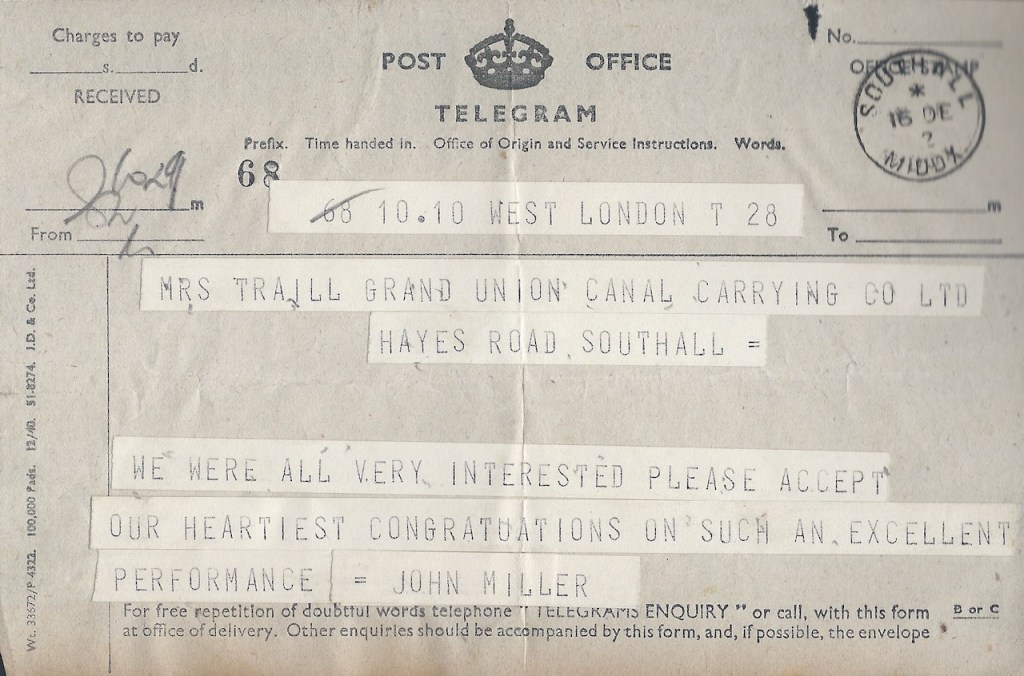
In conclusion, a telegram of congratulations:
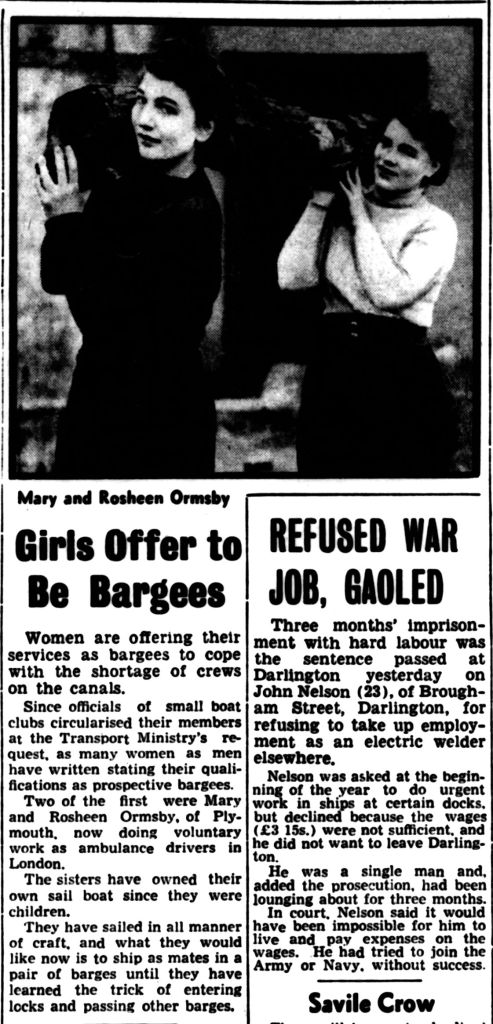
As a footnote, a press cutting about the Ormsby sisters from the Daily News, 28 March 1941:
Website by Crispin Partridge – Grandson of Molly Traill.
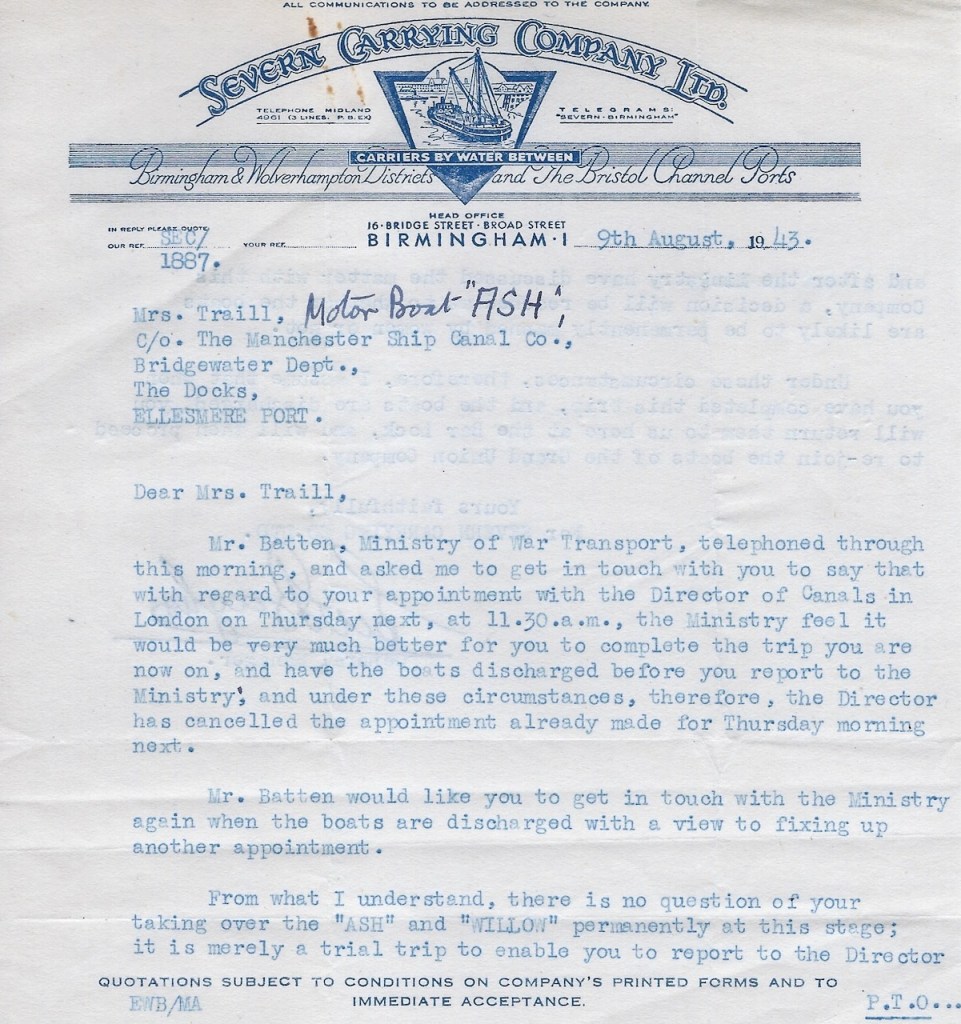
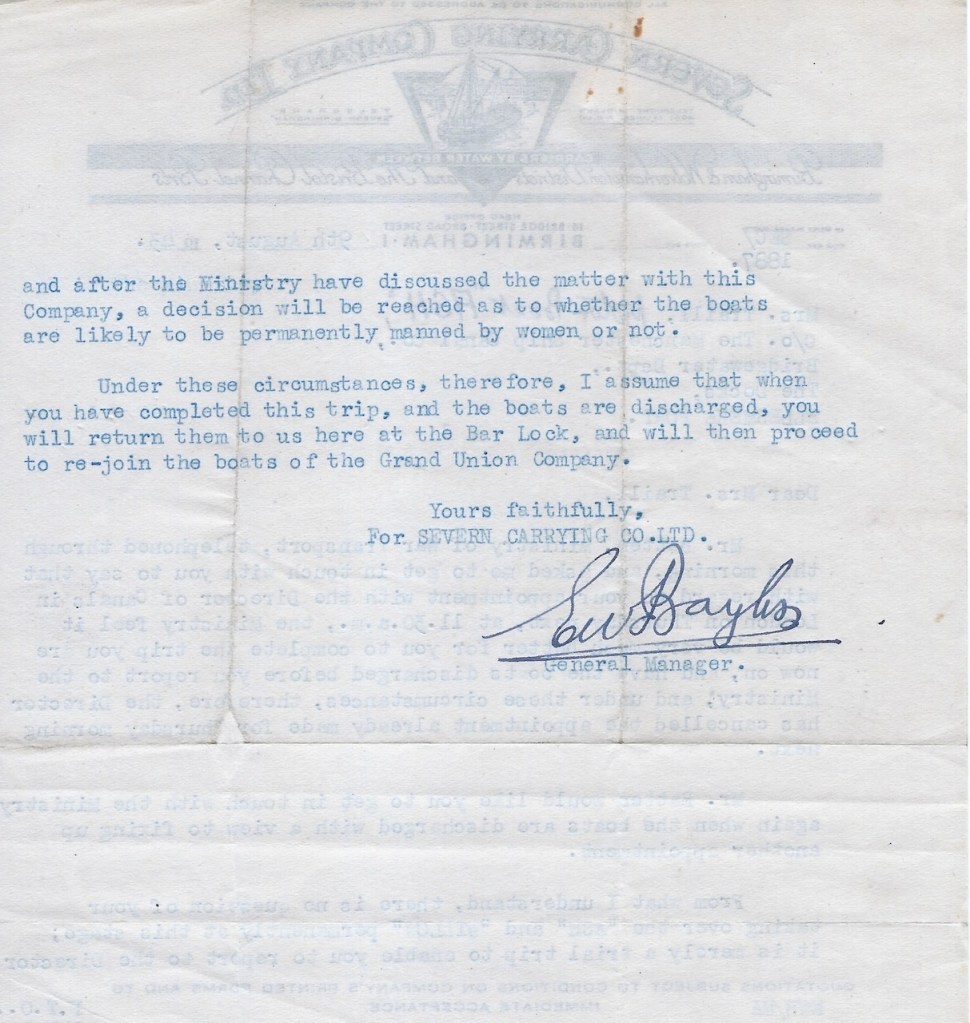
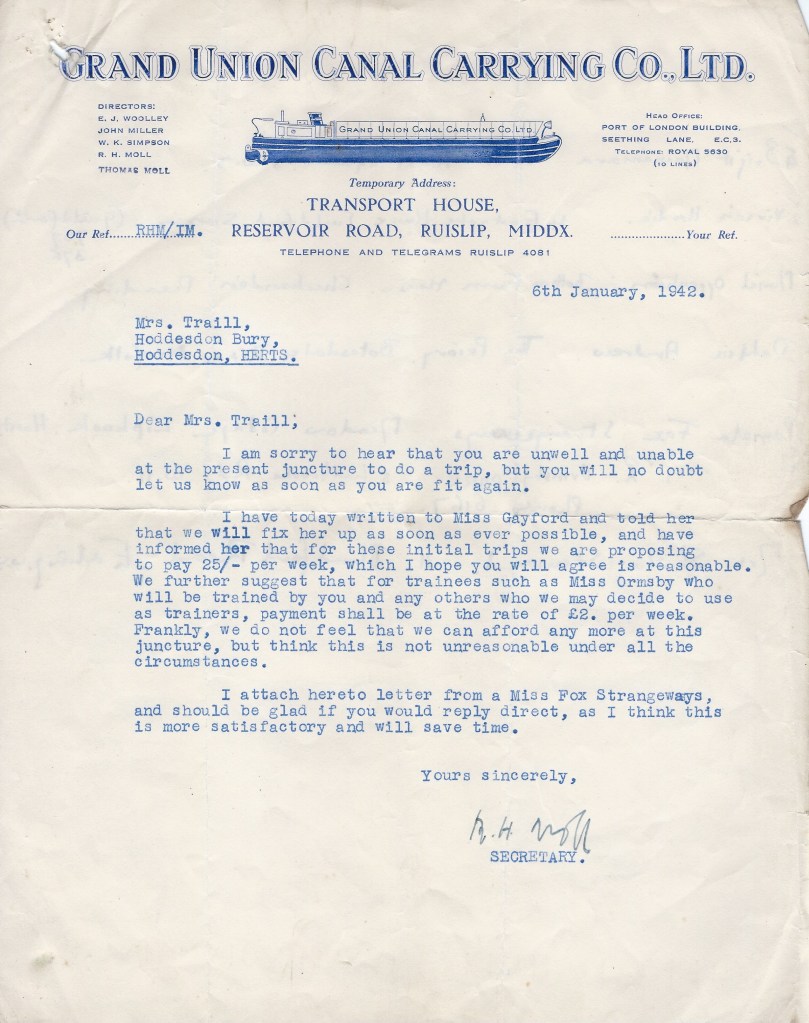
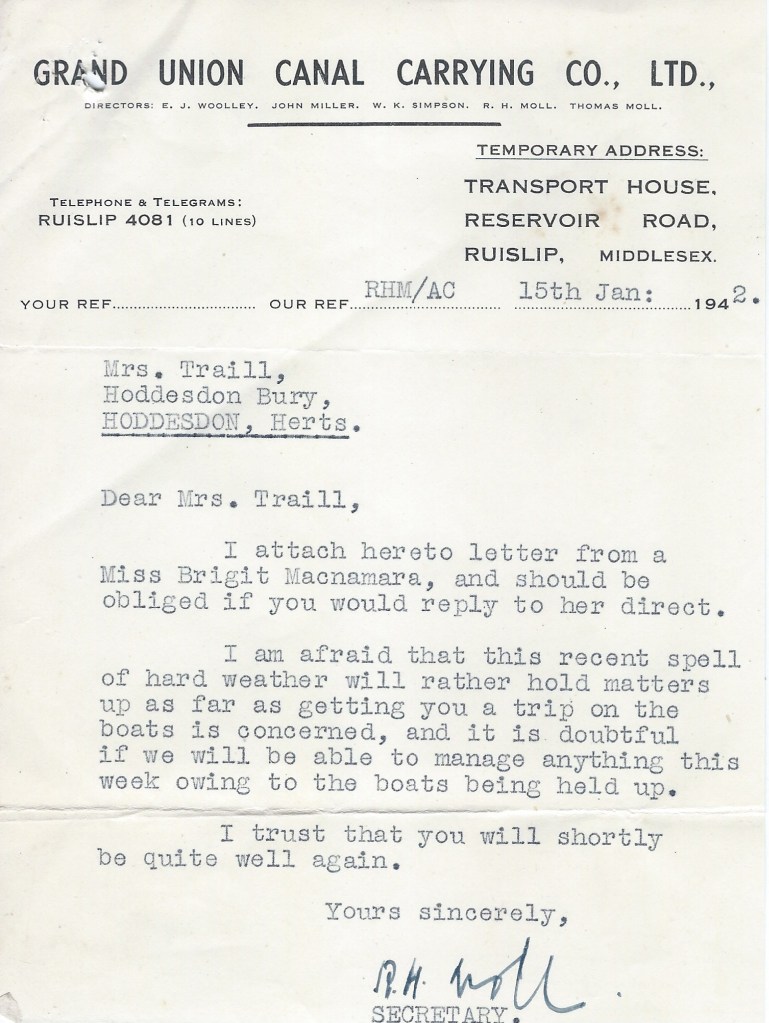
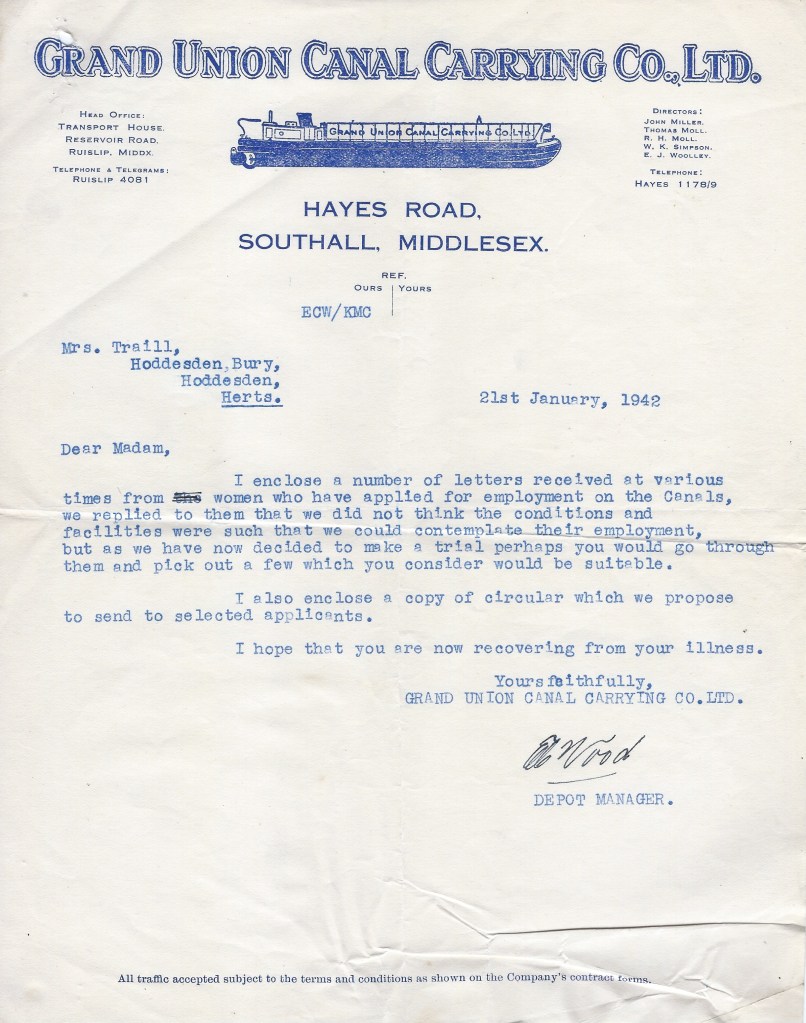
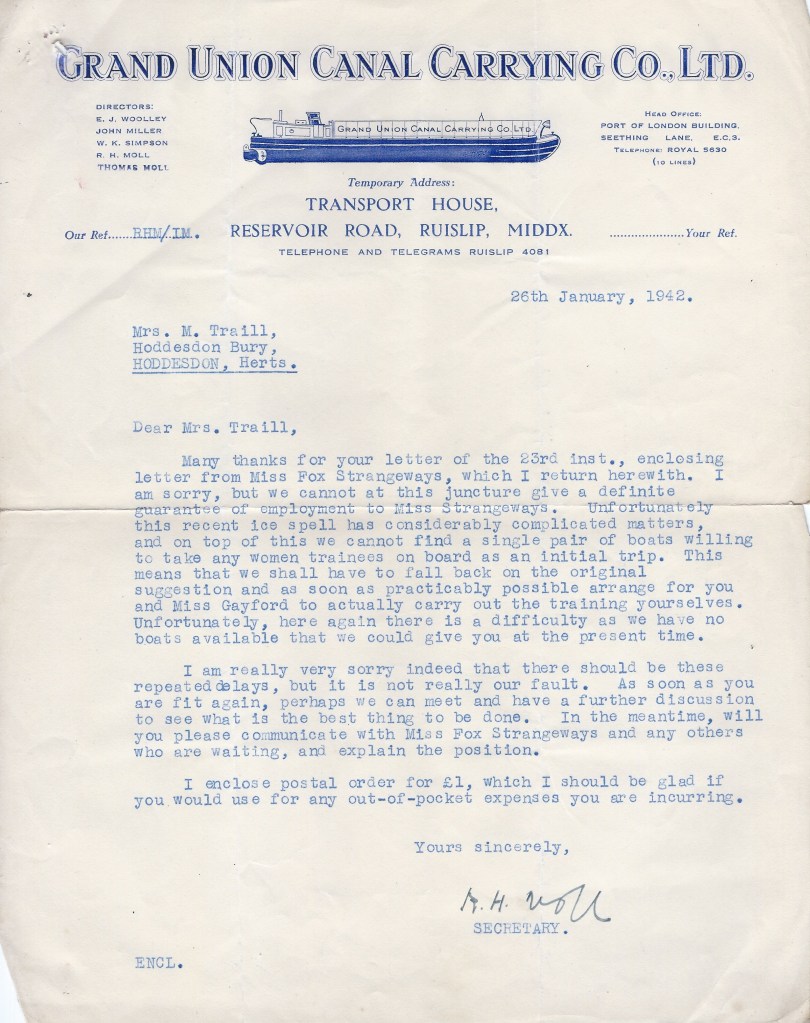
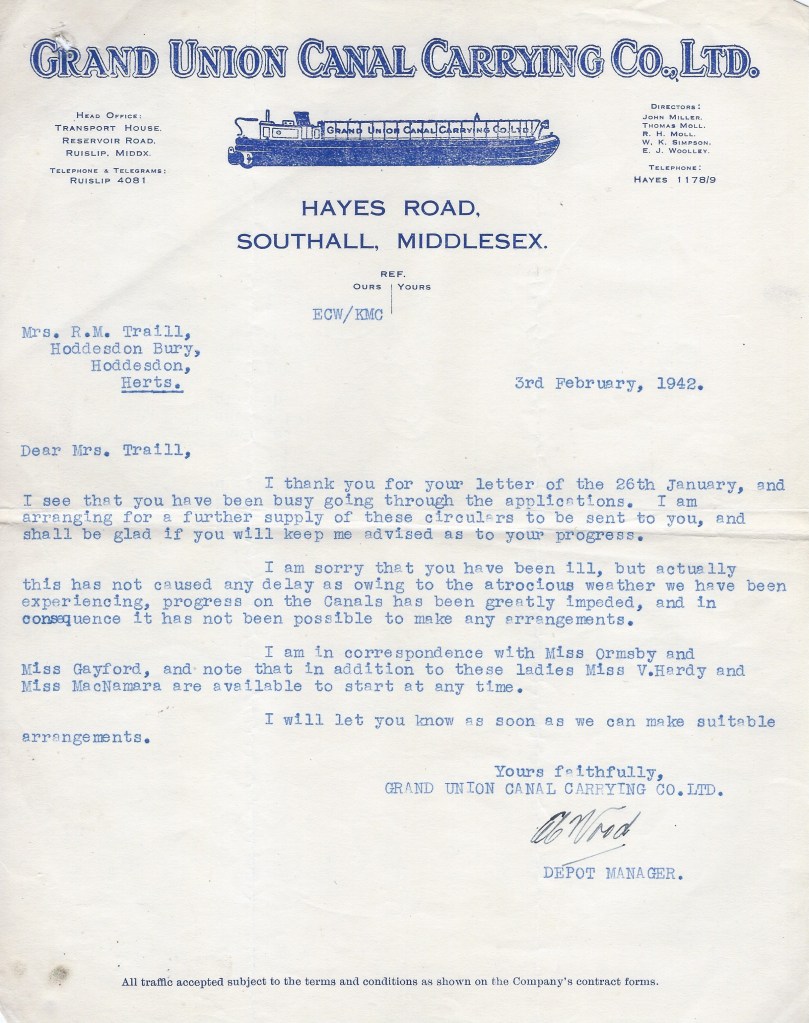
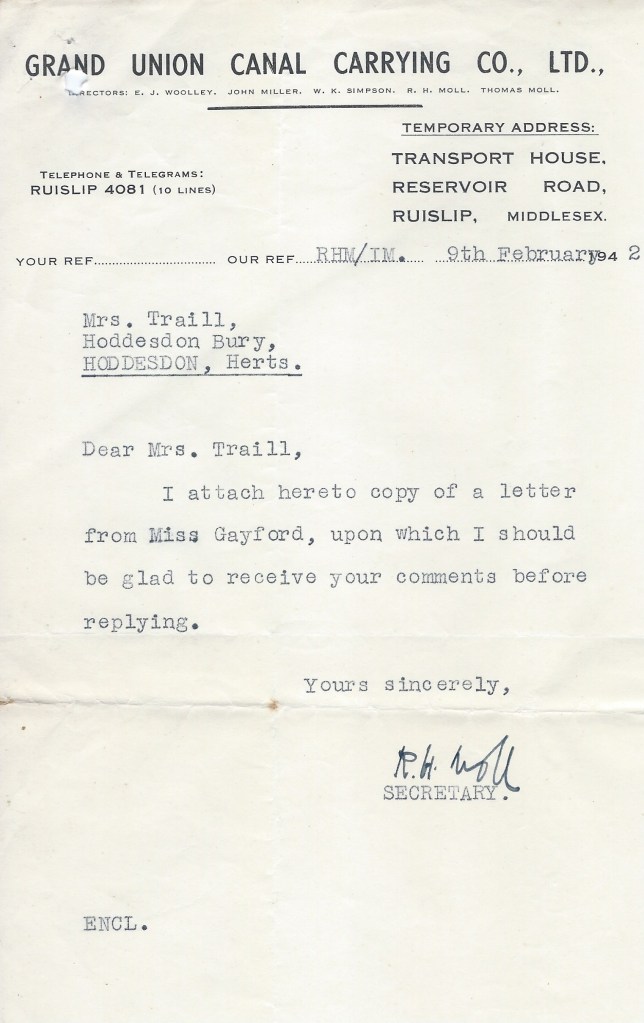
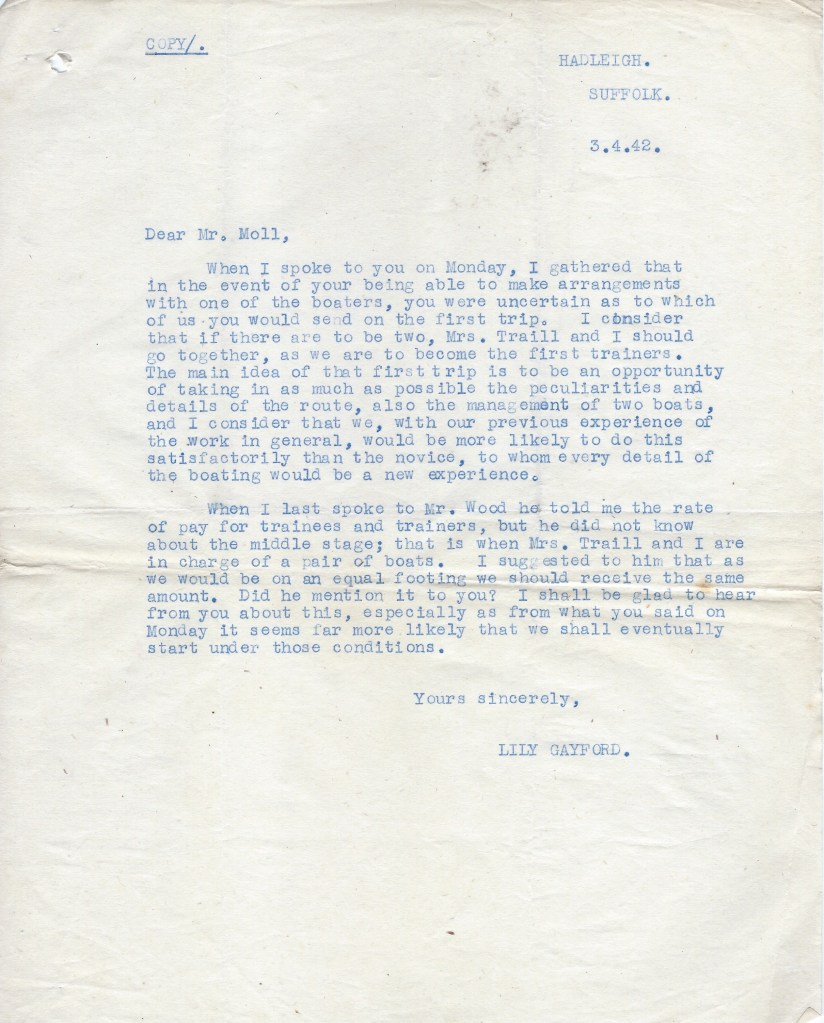
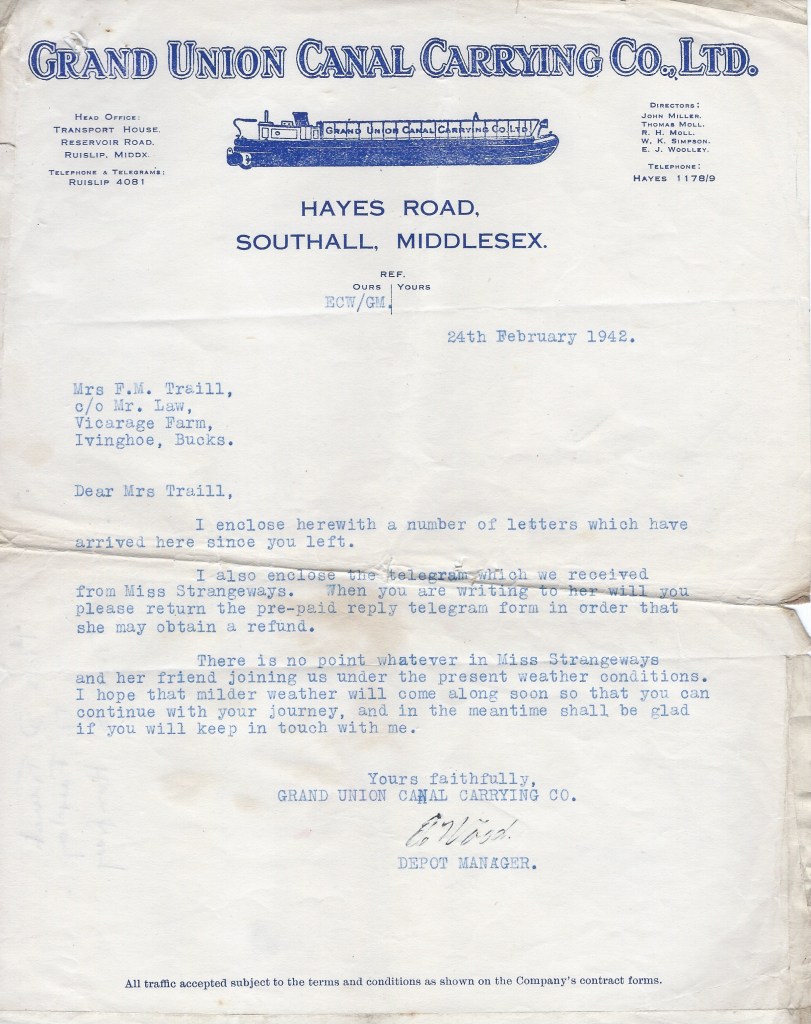
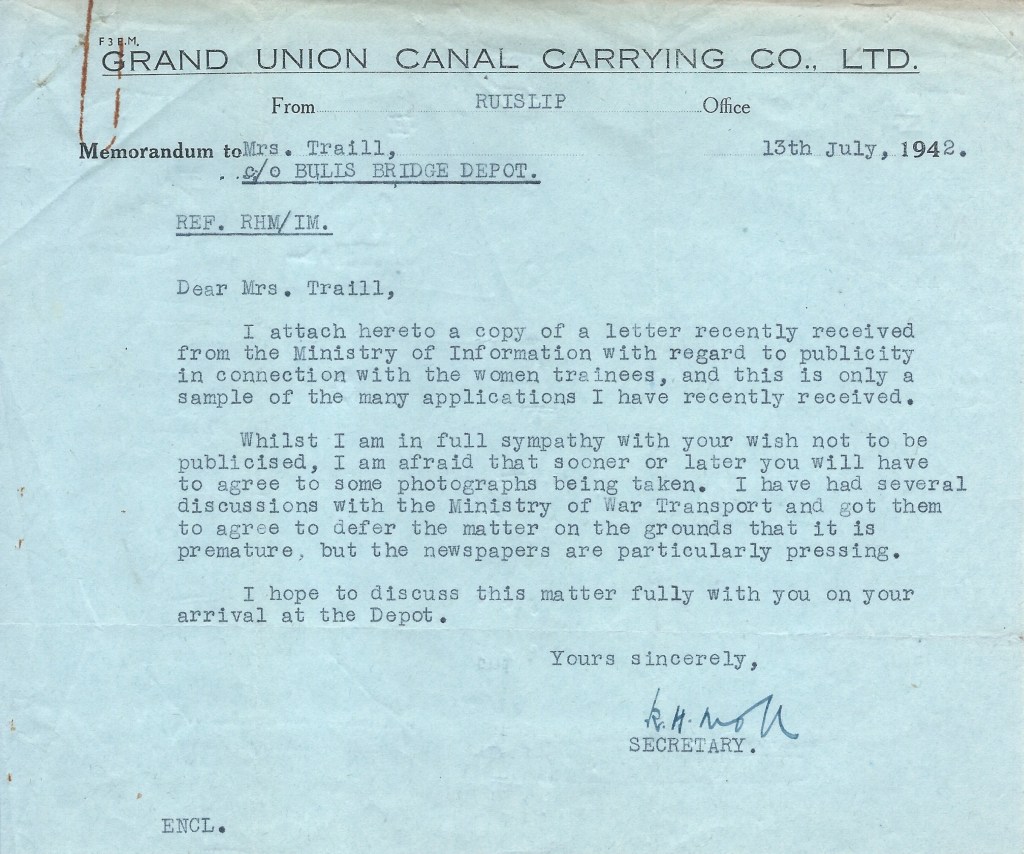
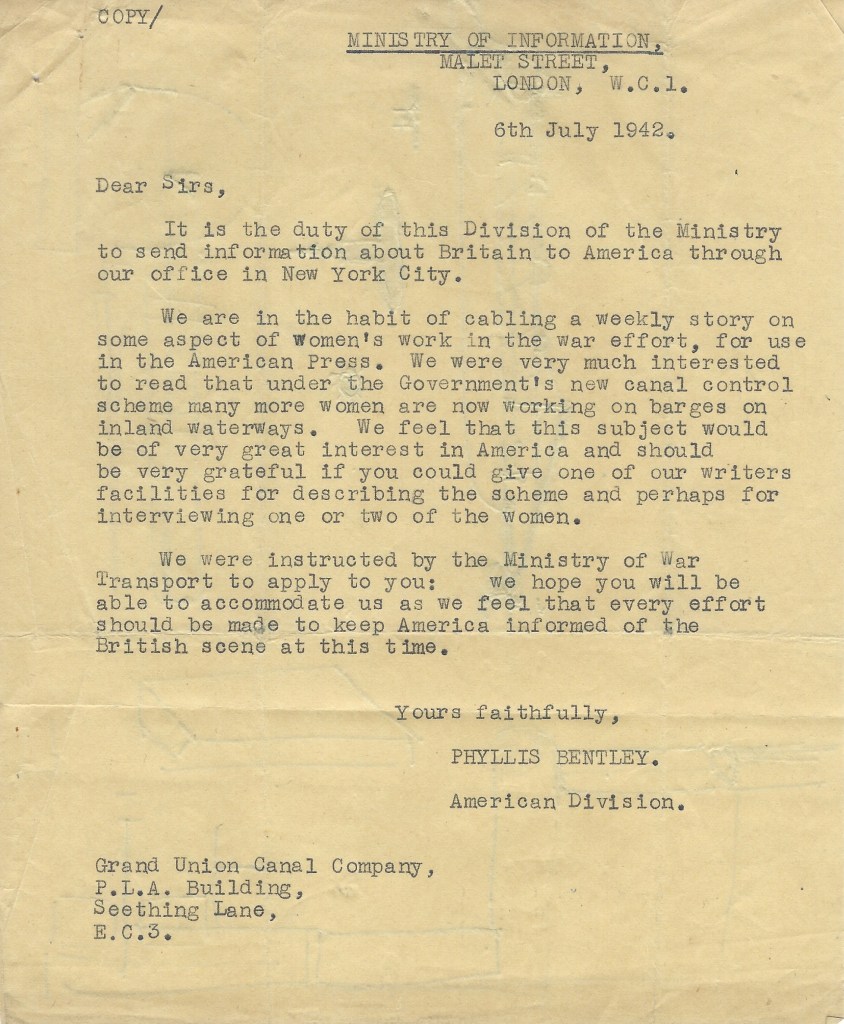
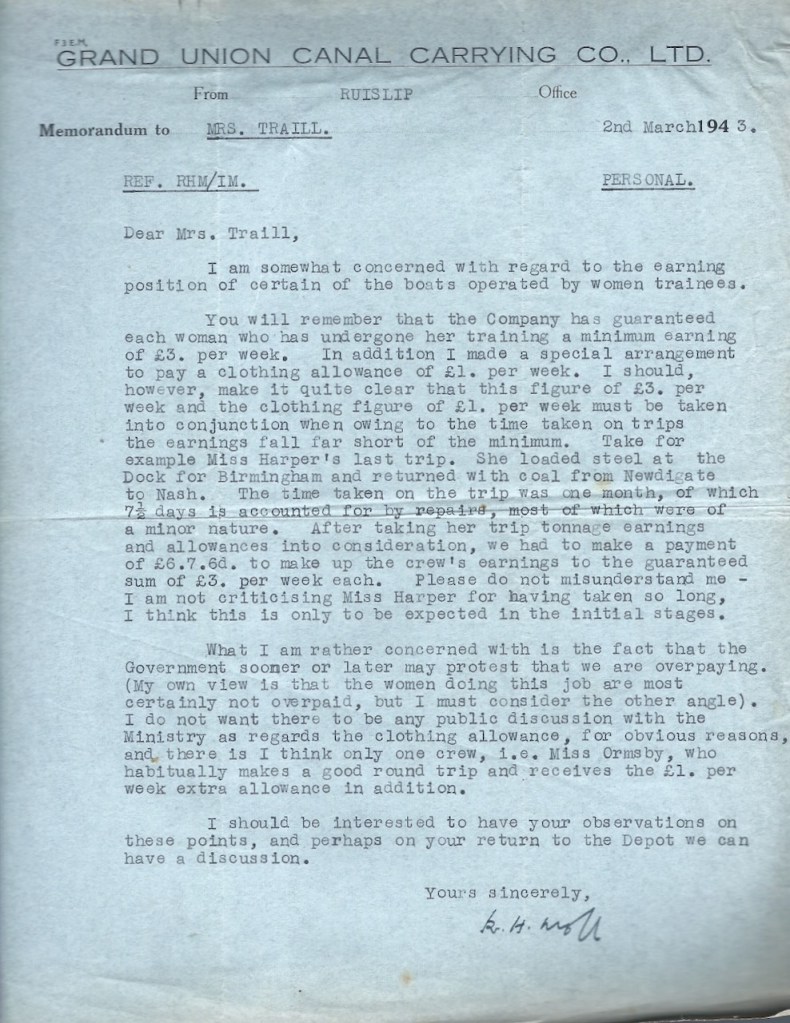
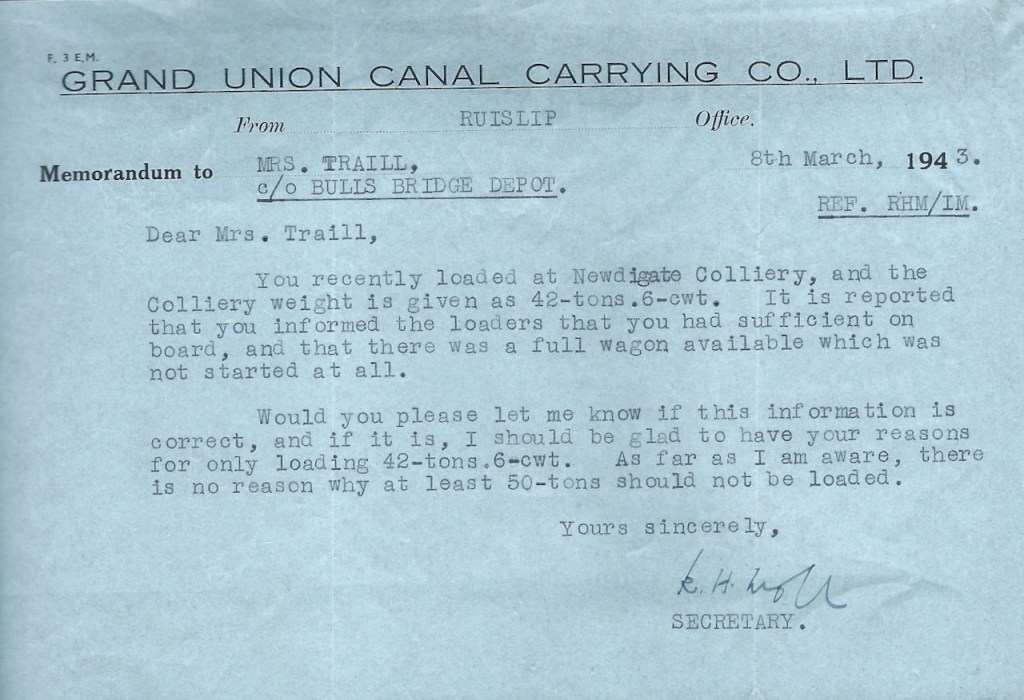
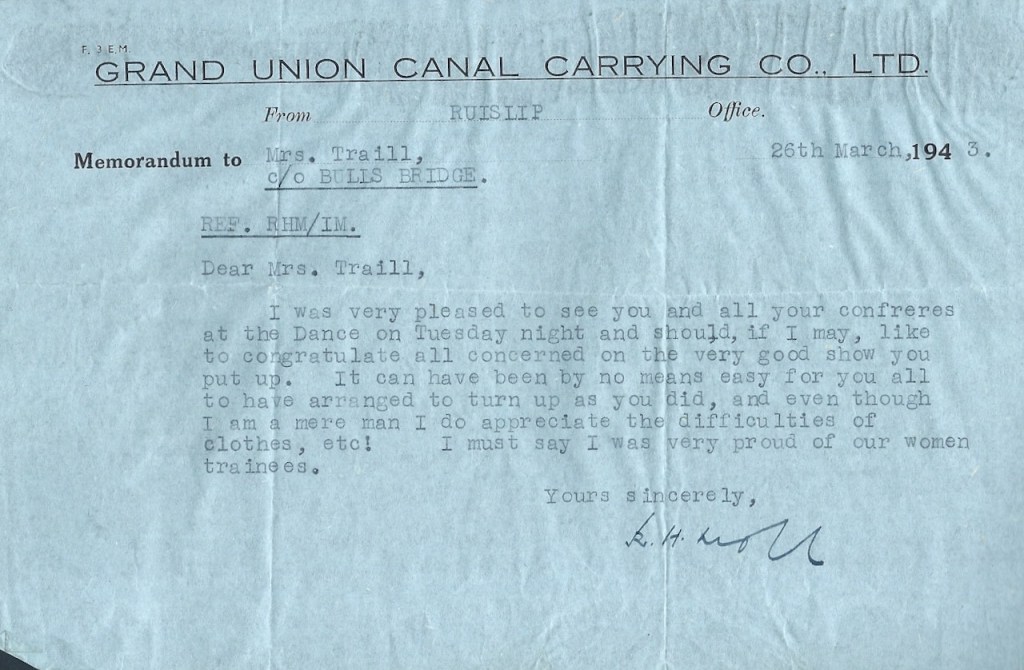
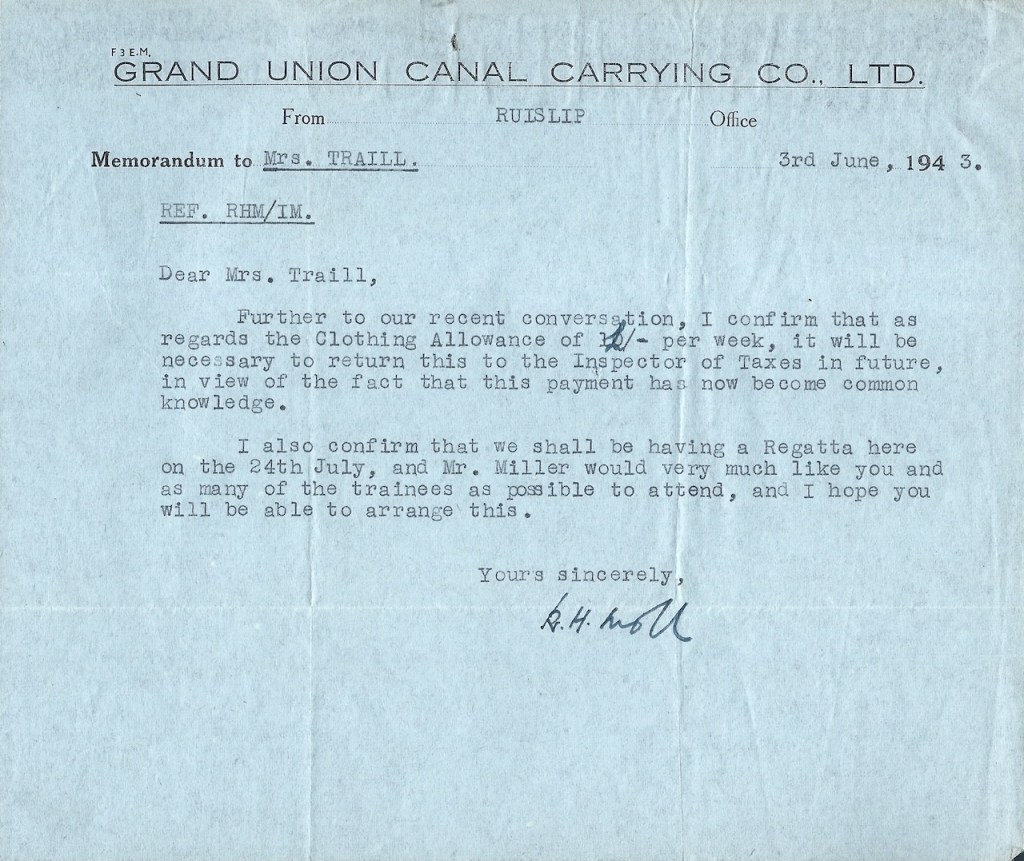
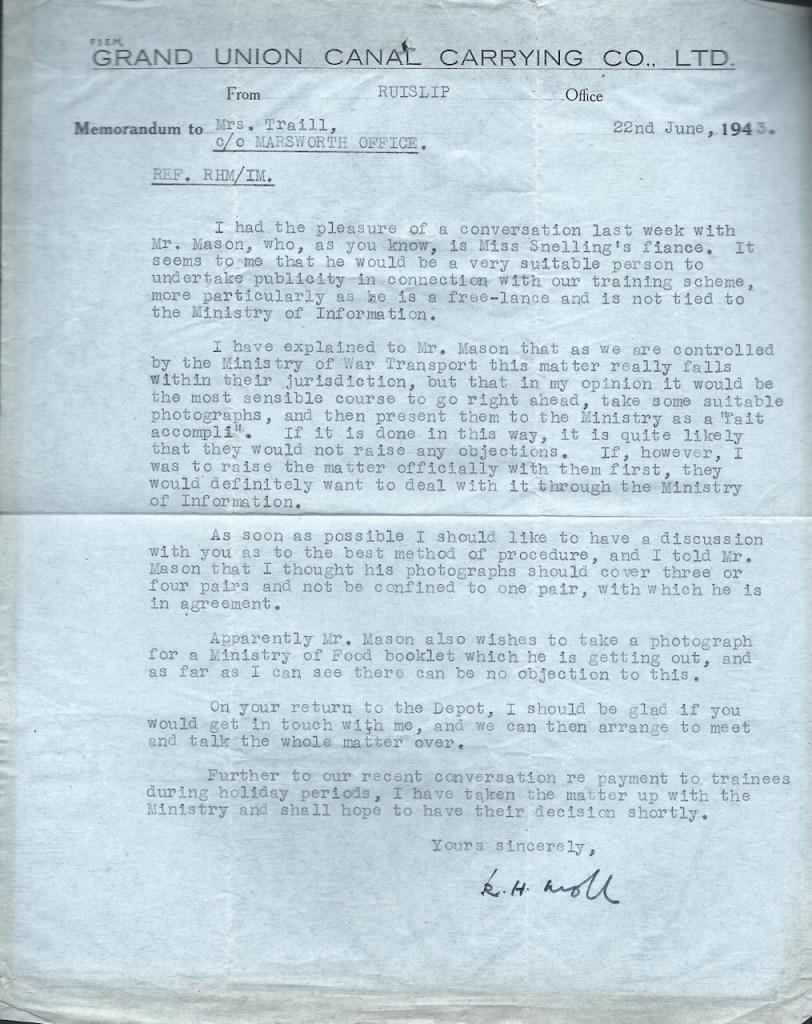
Here are the letters Molly received from the GUCCC. There are no copies of the letters she sent to the company. First – Eily Gayford sets the scene:
A meeting with Molly that afternoon; the next day down to the Grand Union depot at Southall, then over to the head office at Ruislip, and at last back home. Everything was now settled. Daphne was not coming with us, but staying where she was on the Heather Bell, and in the new year Molly and I were to do a trip with a pair of boats worked by regular boat people, to learn the route and the management of a pair.1
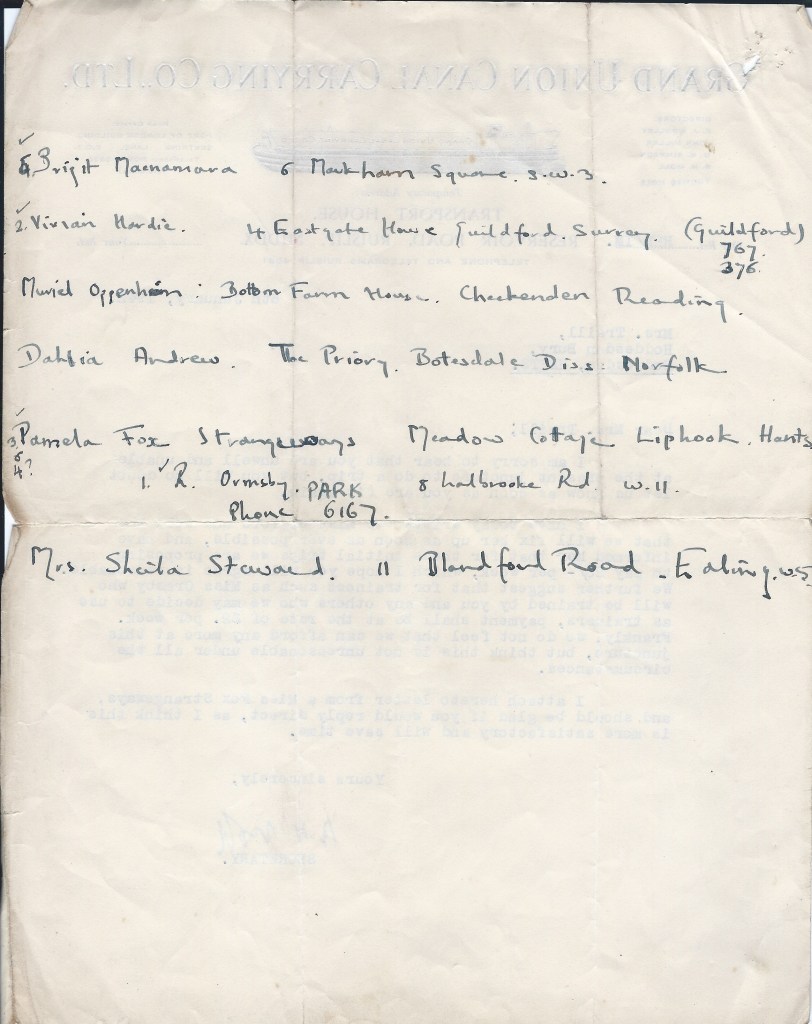
Applicants’ names on the back of the 6th January letter
1942 started with real winter weather, ice and snow, and not the kind which soon disappears. At the end of January, we were still waiting to join the Grand Union. We had written reminding them how anxious we were to start as soon as possible, but they had replied that all transport was being seriously affected by the severe weather conditions, and owing to other difficulties they were unable to say definitely when we could come. So that was that and there was nothing we could do about it.2
This date is puzzling. The GUCCC letter from R.H. Moll above appears to be in response to this letter, and they were attached to one another in the photo album. I suspect that the date should read 3.2.42.
There is then a six month gap in the correspondence while Molly and Eily Gayford did their training trip with Ciss and Albert Sibley.
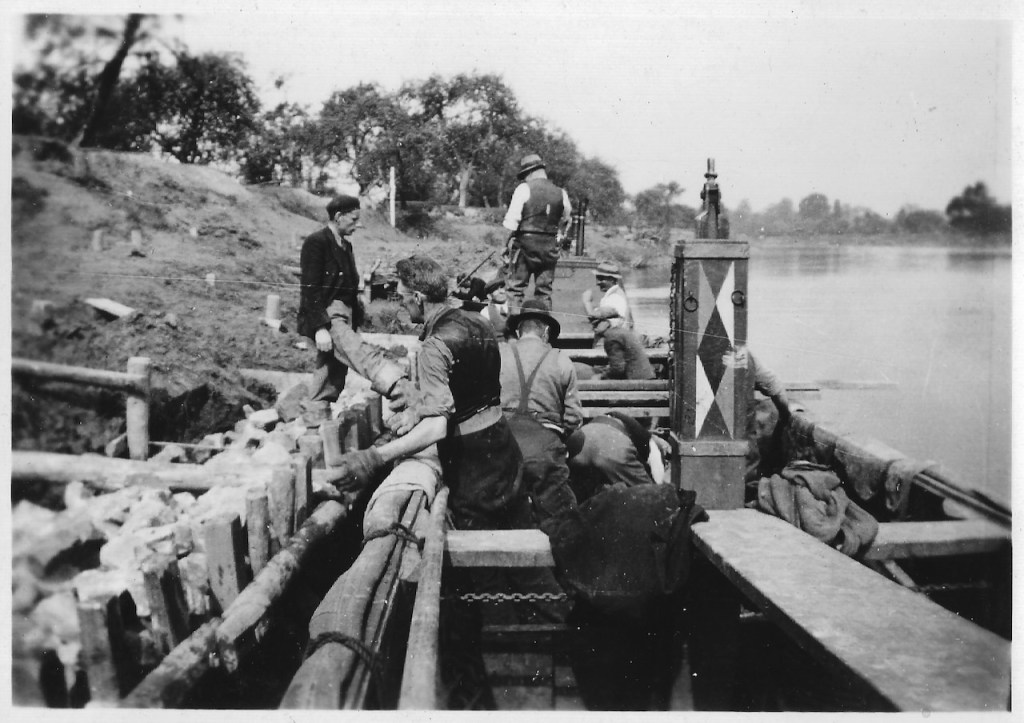
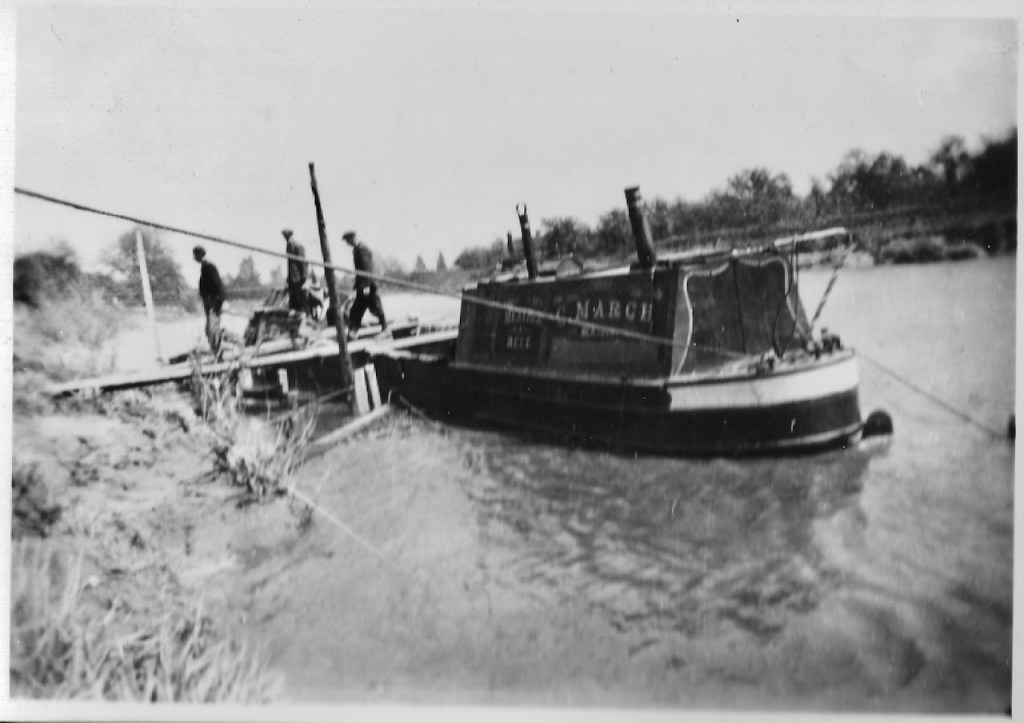
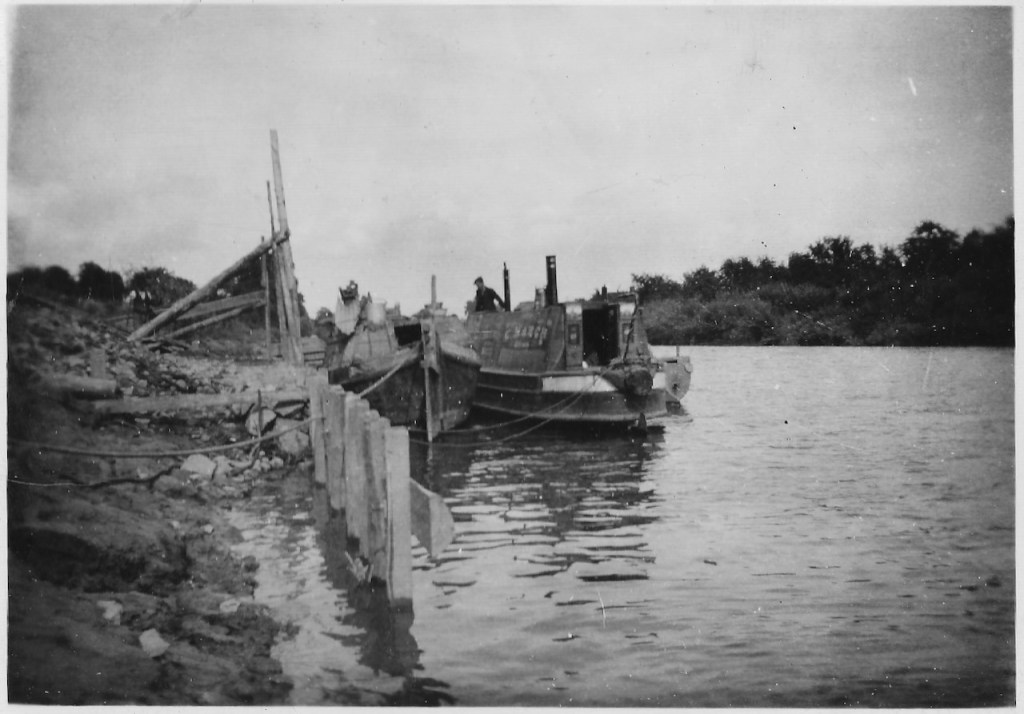
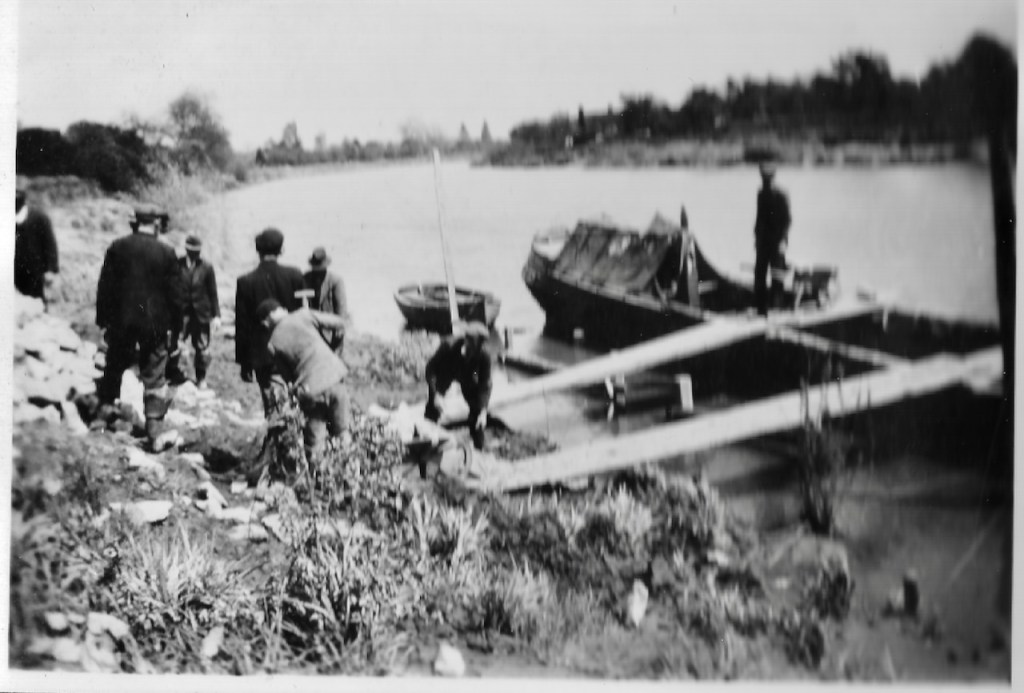
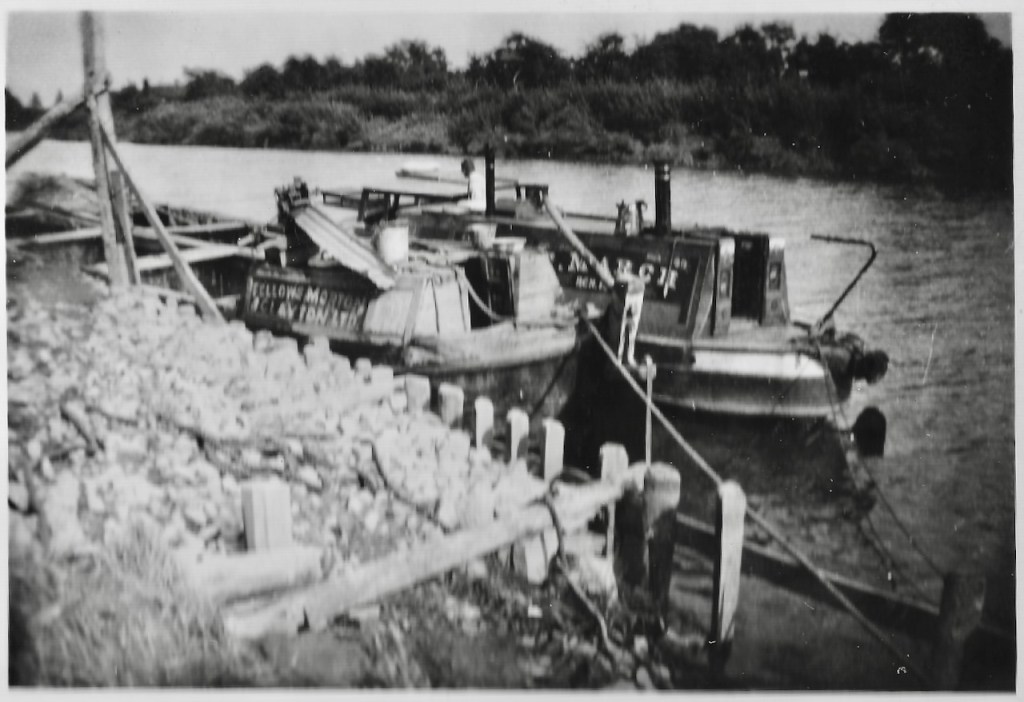
The Heather Bell was chartered by the company [Severn Catchment Board] to carry stone and drop it at specified points, to stop bank erosion caused by the Severn Bore.
Heather Bell, Minsterworth, River Severn – unloading stone into a ‘bay’ caused by bore erosionHeather Bell, Minsterworth, River Severn – the same showing the piles that were driven in to hold the stones in place
This project meant a considerable degree of danger for the boat. She had to be taken over the weir, into the river at Gloucester at the top of the bore level, to a tie-up made especially for her at Minsterworth, where she was based. As can be seen in the photographs below the tie-up consisted of two riding poles allowing for a 15ft rise as the bore came up and passed, and to drop the boat about twenty minutes later when a far gentler wave came down. We had riding chains and cables to the posts and poles, as well as fore and aft anchors. It was the first time a narrow boat had been known to come over the weir – on purpose.
Heather Bell, Minsterworth, River Severn – at top of bore level showing almost complete disappearance of piles in water and length of riding piles left exposedMinsterworth, River Severn – Severn Catchment Length boat and Heather Bell at bottom of bore level
The work had to be done in three weeks to allow for our return at the top of the next high bore. Anchor watch was kept during the highest phase and the return. You could hear it coming from half a mile away, and we stood by on the gang planks with shafts at the ready. Unfortunately we underestimated the length of the highest phase and one night I was awakened by the sound of the anchor chain dragging – I slept in the fore cabin. It was useless to waste time trying to wake Daphne, she was the heaviest sleeper I have ever known. The bore on its return had carried away the fore anchor and I spent the next twenty minutes hanging onto the opposite bank with a long shaft, holding the boat against the force of water, to prevent the stern anchor carrying away. If this had happened we would have been swept onto a shelf of rock only a few yards below. When the force had swept I awoke Daphne and in pitch darkness we got out the dinghy and I rowed the anchor back and dropped it in its original position upstream.
Heather Bell, Minsterworth, River SevernMinsterworth, River Severn – Heather Bell, alongside FM&C boat
From account given by Molly Traill to E.V. Wakelin in January 1965. He was the owner of Heather Bell at the time. Incorporated as part of an article he wrote about Heather Bell, published in Hospital News, Vol.7 No.1, March 1965 – Northern Ireland Hospitals Authority. Only the third and fourth of these six photos were published in that article.
Website by Crispin Partridge – Grandson of Molly Traill.
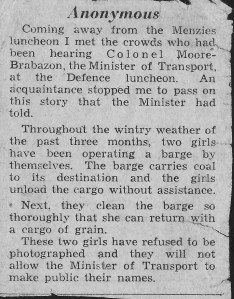
The two ‘girls’ were Daphne March and Molly Traill. The following is Molly Traill’s account of that time:
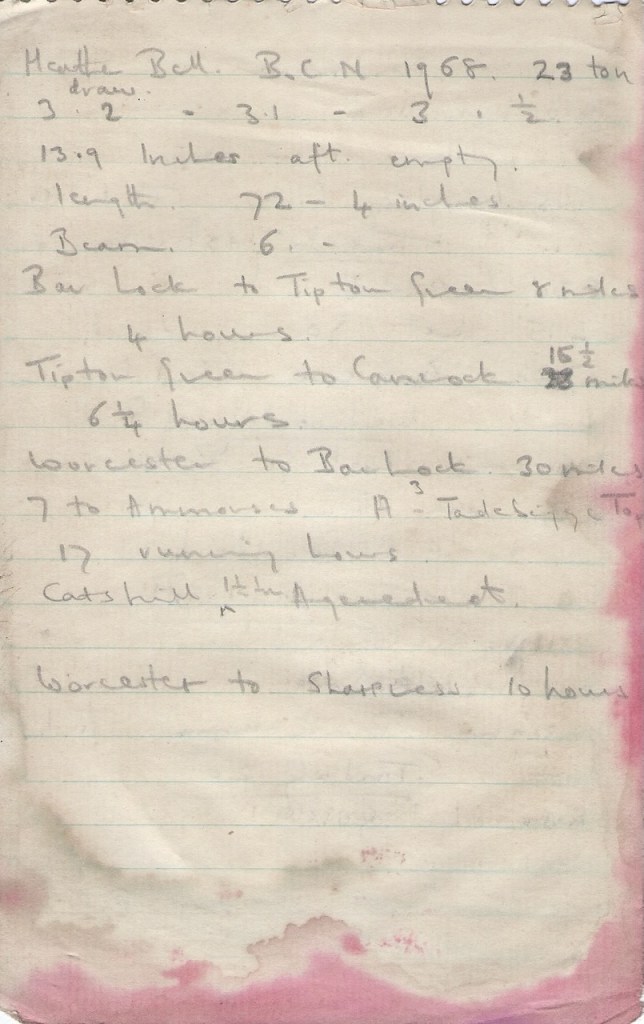
“Heather Bell carried 23 tons and drew 3ft 2ins. Her weekly round trip was from Townshend’s Mills, Worcester
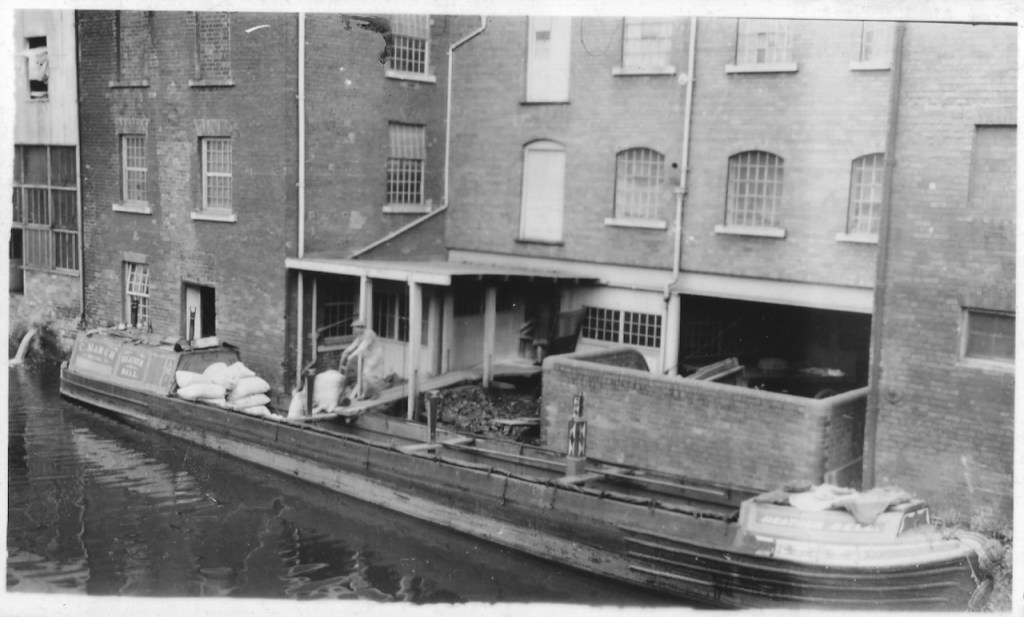
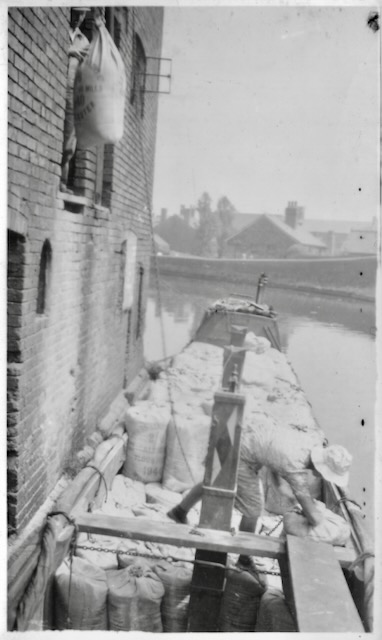
Heather Bell – loading flour at Worcester, 1941
into the Severn via Tewkesbury, passing the branch of the Lower Avon Navigation to Gloucester, into the Berkeley Ship Canal through the Framlode Lock passing the branch of the Stroudwater Canal, to Sharpness Docks. There we loaded grain direct from the ships. Clothed up and back to Townshend’s. Unloaded. Loaded flour. Clothed up. Left Worcester for Birmingham via the Worcester-Birmingham Canal. This is the cut of the famous ‘thirty and twelve’ locks. There are a total of 58 locks in 16 miles from the River Severn at Worcester to the 420 ft level at Tardebigge.
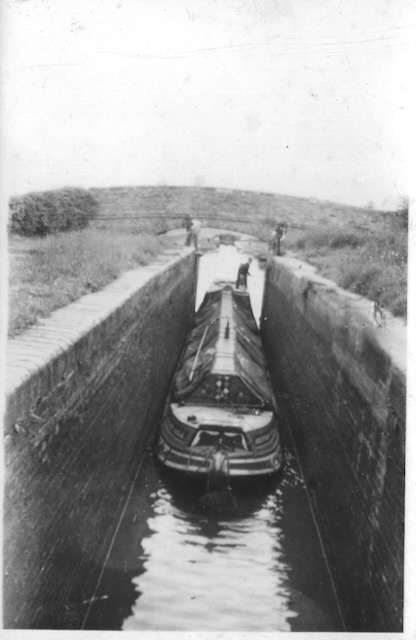
Heather Bell in all her glory in Tardebigge Summit Lock. She is clothed up, the tie ropes are blancoed and the spare end curled in a spiral. The long shaft is tucked handily under for winding round in the basin. Painted in the traditional manner by Mr. Nurser of Braunston, she has roses, cornflowers, daisies, anchors, diamonds and hearts on cabin slides and side and on the cratch board and stands. And in the cabin on the doors and walls the castle picture with its turrets, red roofs, water and boats. There are brass bands round the chimneys and brass rods above and around the cooking range. Her tippits and ramshead decorated with turkshead knots are also blancoed, and on the cabin top is the rose covered 4 gallon can which carried our only water supply.
Here at the Summit Lock is the deepest narrow canal lock in England, it has a fall of 14ft. Besides this feat of ‘locking up’ we had to get through five tunnels before reaching Birmingham: Dunhampstead 230yds, Tardebigge 580yds, Shortwood 613yds, Wast Hill 2726yds and Edgbaston 105yds. We carried a ship’s copper oil lamp on the bows. Showers of water came through the roof in unexpected places. Often the tunnels were full of smoke, if other boats were passing in it or a tug had been through pulling a string of we used to meet L.T.C. Rolt when he was tied up at the middle lock basin of the Tardebigge flight. On his motor boat Cressy he was writing ‘Narrow Boat’.
At King’s Norton the Heather Bell branched left for Birmingham, leaving the Stratford Canal on the right and made our way through filthy water to Tipton Green. If the weather was fine one of us would steer while the other unclothed ready for unloading.
Heather Bell – unloading flour at Tipton, 1941
It was in this stretch that we experienced one of our worst air raids in the war. Being balanced on water when buildings tumbled gave you a carefree sense of safety.
Gas Street was one of our favourite tie-ups. The 15 miles to Cannock in Staffordshire was full of snags. Motor tyres, wire and dead cats wound themselves round the prop, and stopped the engine. Once we had to borrow a pair of industrial shears from a wire factory to cut off the yards of heavy stuff that had come from their own works, and this standing in mud up to our thighs, and water to our armpits. The canal had not been dredged for sixty years, and it was the passage of the boats that kept the channel clear.
Heather Bell had a Petter engine which, once it started, never stopped except in cases such as this. It was a ‘cold’ starter, that is you heated a nipple on the top of the cylinder with a blow lamp, and then swung by hand a vast brass and steel flywheel. If you put your strength into it at the wrong moment it would go in reverse and you had to begin all over again. The base of the flywheel was an inch clear of the bilges. Heather Bell leaked and had to be pumped out frequently. If you failed to do this, on starting the engine the wheel picked up the greasy coal water and sprayed it all over you and the engine room.
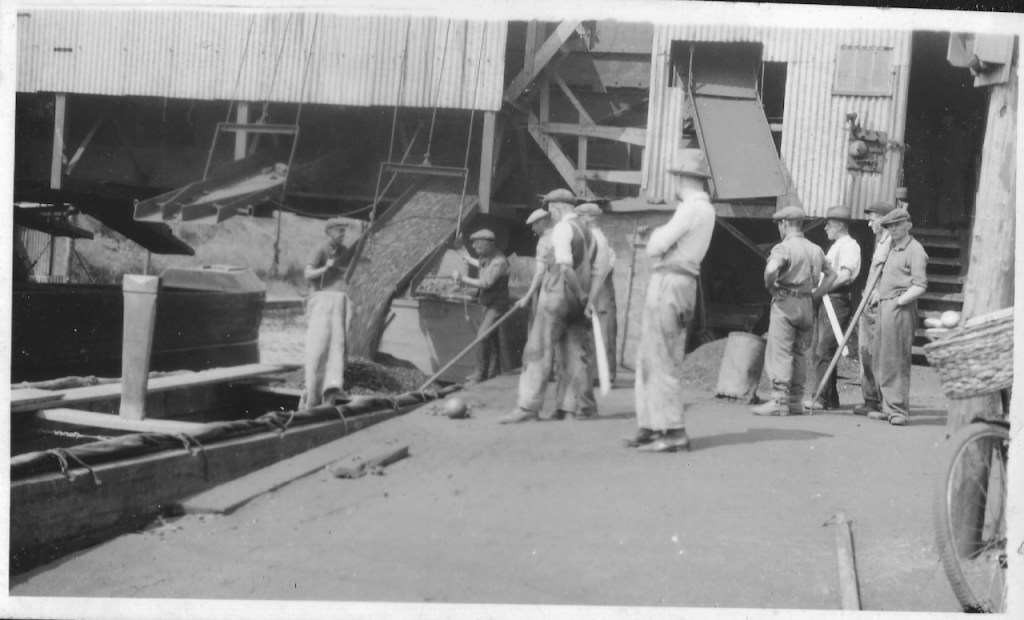
Heather Bell – loading slack at Cannock, 1941
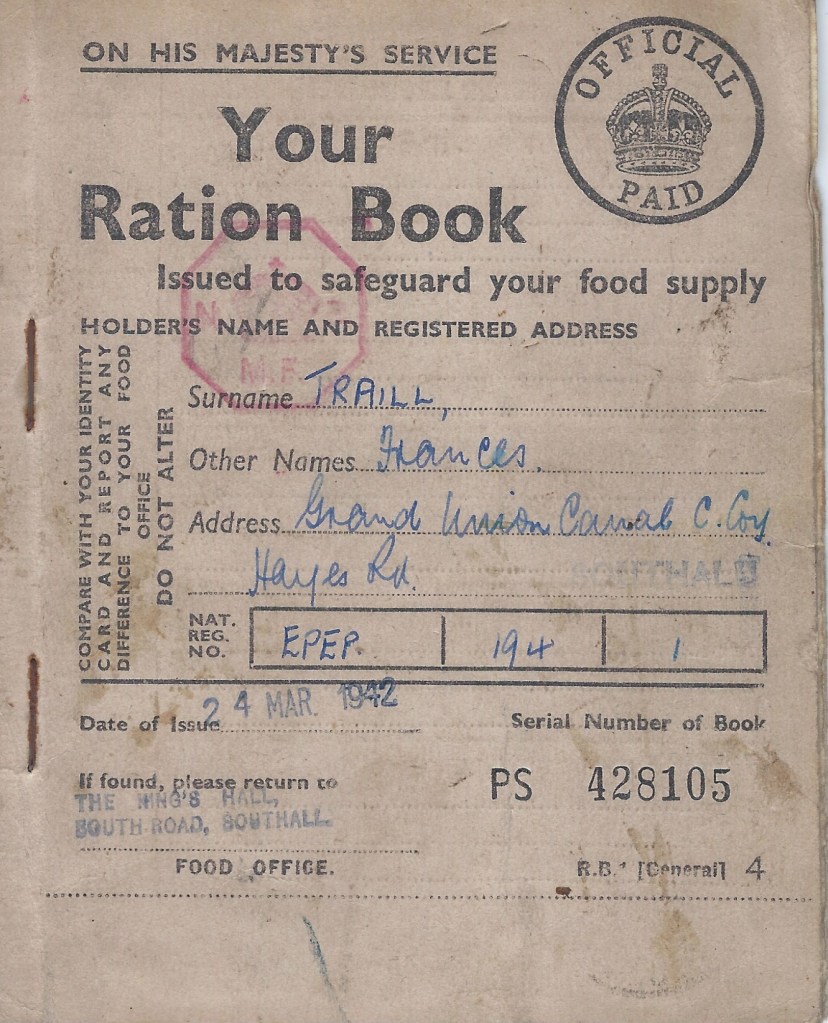
At Cannock we loaded ‘peas’, a very fine coal that was essential for the type of furnaces at Townshend’s. This was dropped direct from a chute at the mines. Curiously enough it was in the pools here that we used to wash our hair, the water was glass clear and mirrored the coal lumps in the bottom. We saved up for some of our finest meals, there was plenty of fuel at hand and, as long as we were on the Sharpness run, Seaman’s Ration Books were issued to us as it was the tidal waters. I believe we were the only two women in the country to have them.
The return journey of 63.5 miles took two and a half days and part of those two nights.”
From account given by Molly Traill to E.V. Wakelin in January 1965. He was the owner of Heather Bell at the time. A small part of the text on this page was summarised as part of an article he wrote about Heather Bell, published in Hospital News, Vol.7 No.1, March 1965 – Northern Ireland Hospitals Authority. However the majority of this text has not been published until now.
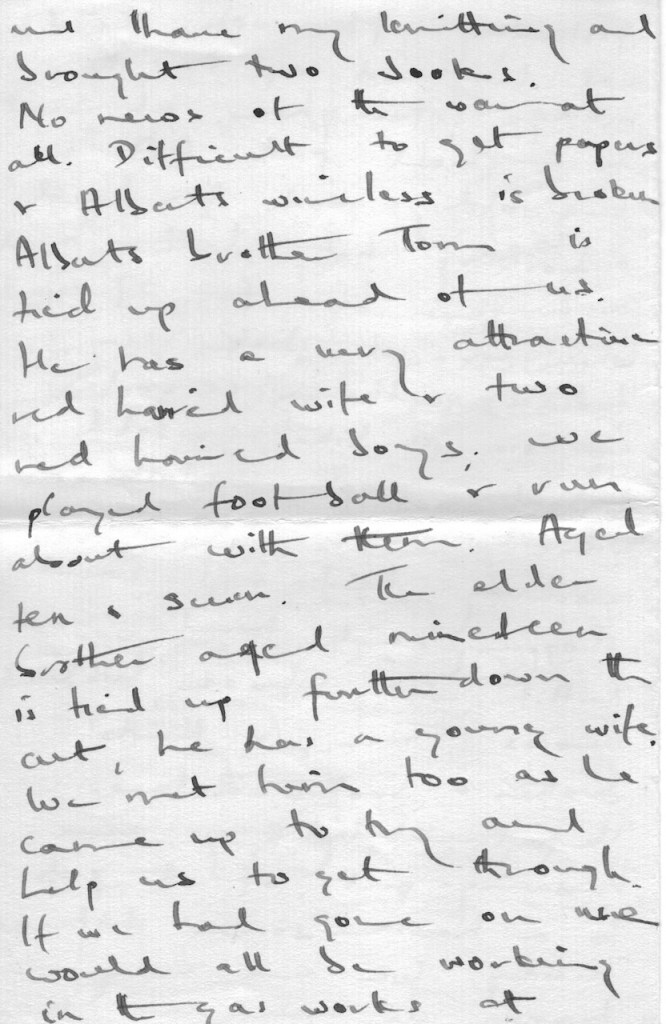
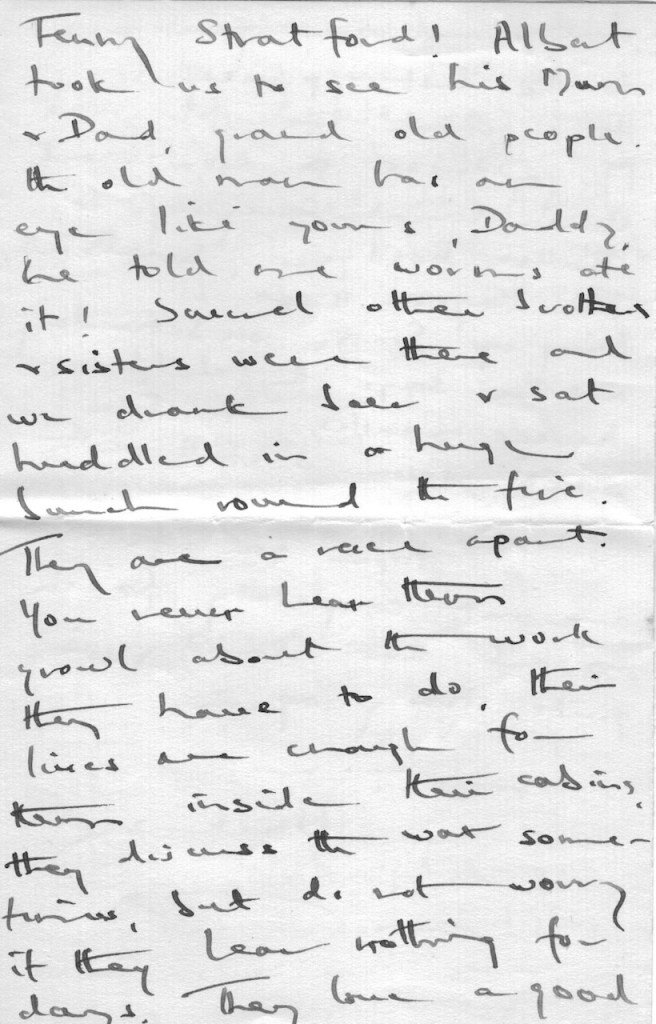
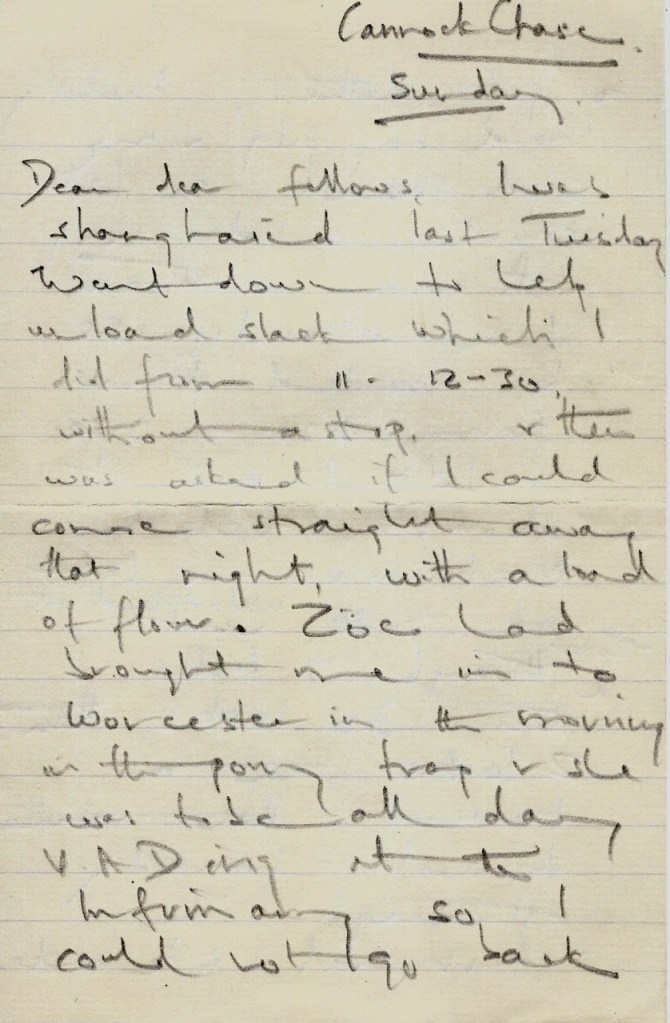
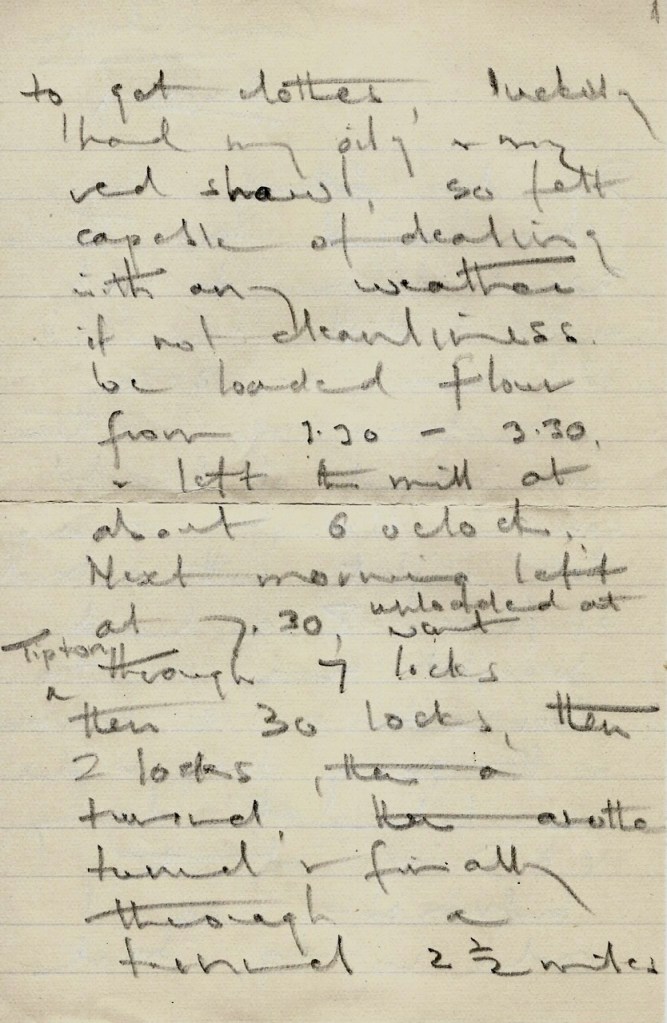
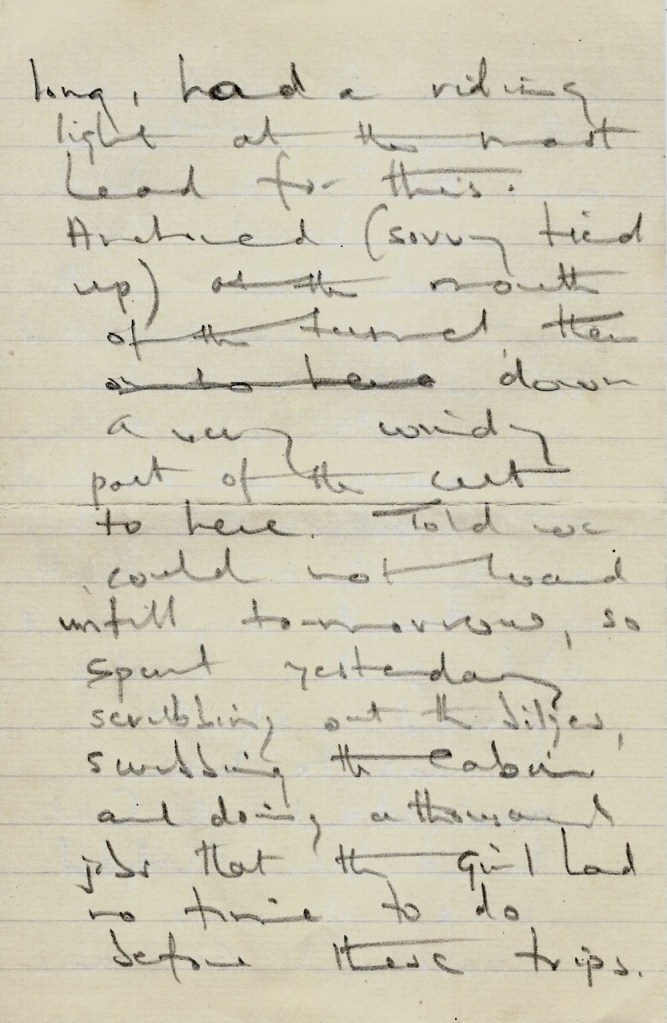
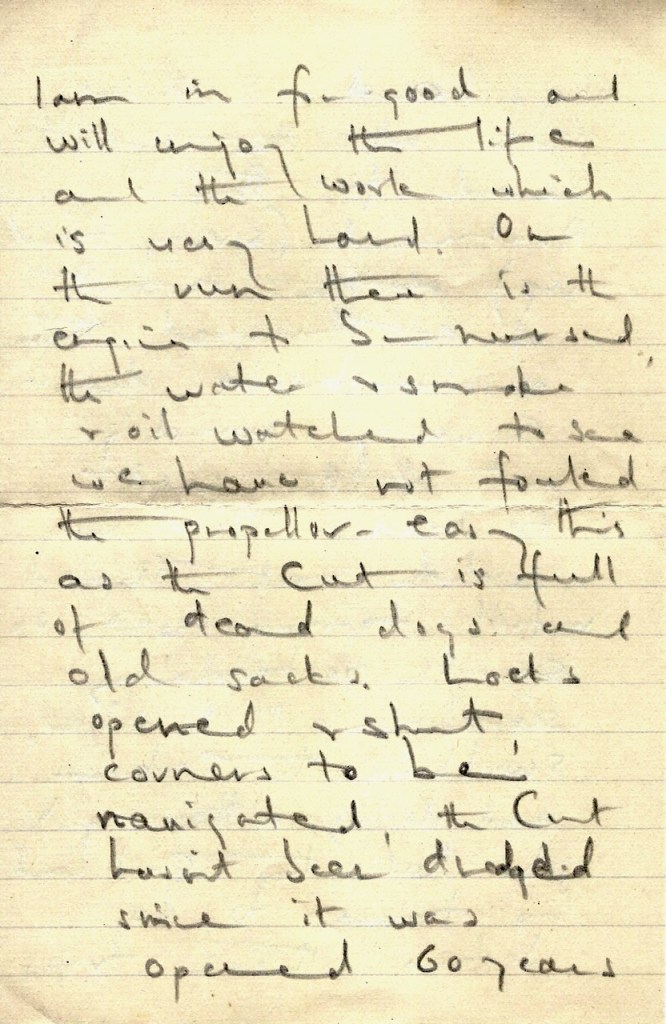
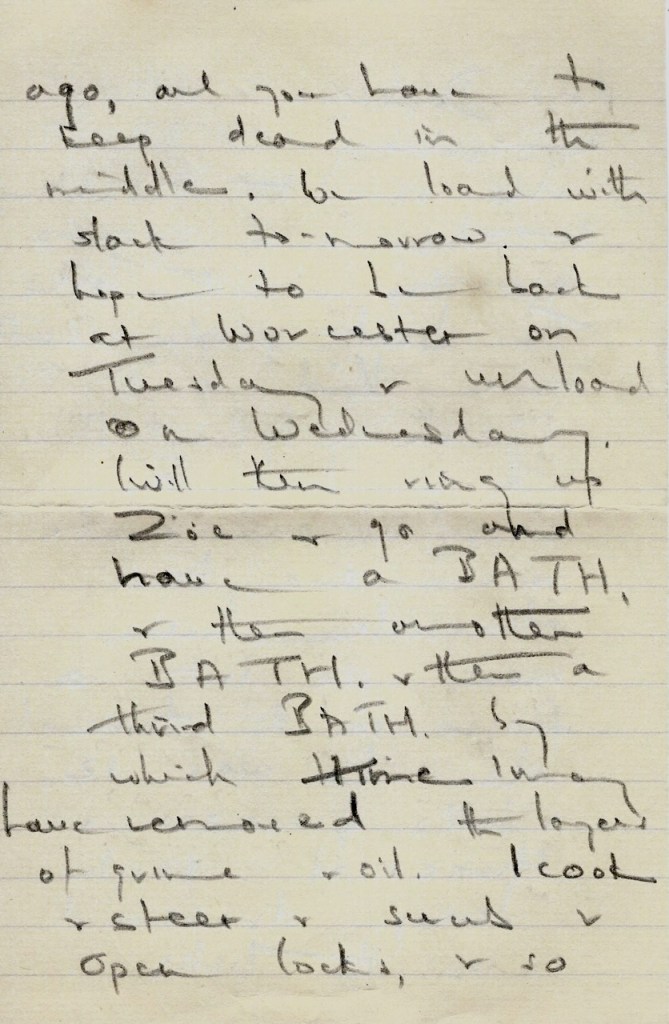
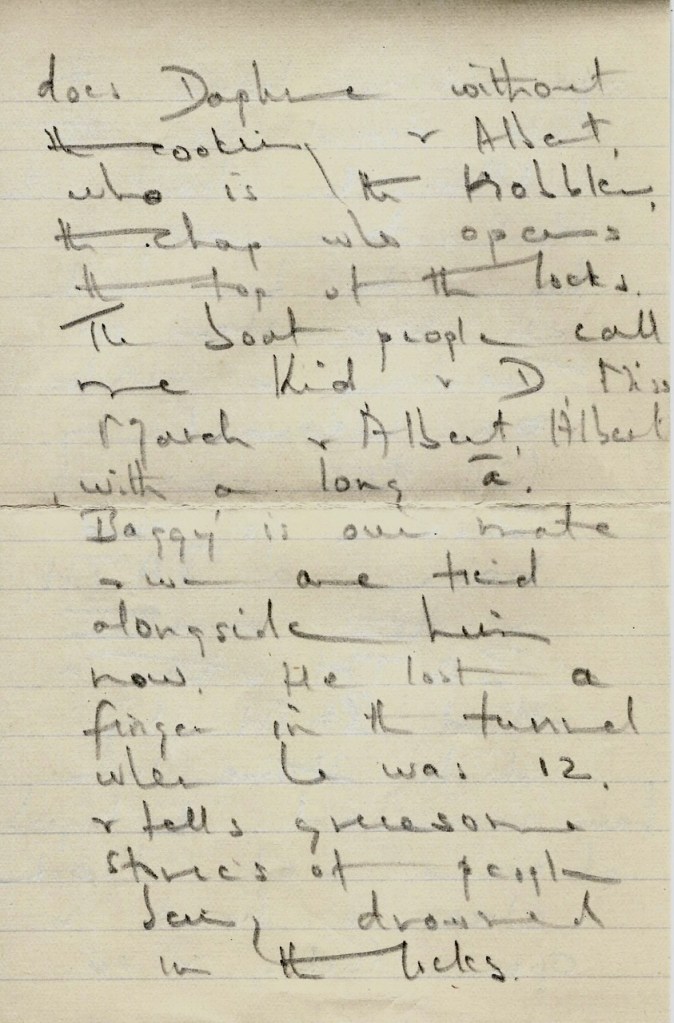
Reproduced below are the notes she made at the time about these trips:
For a first hand account of the trips see Molly’s Letters Home page.
On six pieces of paper there are various parts and versions of a poem that Molly wrote about Heather Bell. I reproduce them here, but it needs a poet to put them together into a coherent whole. And, I’m sorry to say, it is not a particularly good poem – I can see why she abandoned it!
Our boat was ‘Heather Bell’ As it should was built of wood With roses everywhere
‘Heather Bell’ she was named And girls we trained To carry bombs and butter
The girls we trained And girls were lamed Leaping from boat to lock
That name renowned in fullest view! Willy Nurser we loved and knew As wartime boaters
Through tunnels dripping dank ‘Footing’ on a plank And the puttering of the Diesel
We fell into the “bloody cut” Simply told “you are a mutt” Surfaced clutching treasured dock
How good it was to reach our dock To wash our clothes and hair And sluice down in the ‘bare’
Tarpaulin sheeted And carefully treated Ropes coiled and blancoed white
Our cargo was our wandering child From Limehouse to the West But London was the best
‘Heather Bell’ our boat was named When last we saw – How she was maimed No roses anymore
But she had come to Stratford From a far and Irish shore Loved and cherished as before And brought there in a tanker!
The last two verses refer to a chance meeting that Molly had with the owners [from Northern Ireland] in 1964 in Stratford, presumably at a boat rally.
Website by Crispin Partridge – Grandson of Molly Traill.

 Molly Traill Archive